Saturday, 31 May 2014

Week 38: El Salvador

Week 38: The Lighthouse of the Pacific.
El Salvador is the smallest, yet most densely populated country in Central America. Affectionately known as the Tom Thumb of the Americas, it is also a country with a history of destructive earthquakes and volcanic eruptions. Andrew told us last night that there are no fewer than 20 active volcanos, with glowing lava and brilliant luminous cores, shooting flares visible for great distances at sea - hence the nickname The Lighthouse of the Pacific. And Finn noted that it is the only Central American country that does not border the Caribbean Sea, but has amazing surfing beaches on the Pacific side of the landmass.

El Salvador further suffers from a fragile and unstable political climate - coup d'état, guerrilla warfare, rural revolt - these terms are all part of the national lexicon, together with drug cartels, human trafficking, extortion and coercion....another country where the good news story is hard to find.

For this reason, Luz de Maria Bara (an economist) and her husband (a vet) left El Salvador and moved to Australia in 1989. The largest group of Salvadorians migrated to Australia during the political unrest in the 80's. Today there are about 17,000 Salvadorians who created a new life in Australia, of whom 1,233 chose Brisbane...primarily for the weather. About 8 years ago Maria opened Villa Maria in Camp Hill, a suburb 5 km south-east of the Brisbane CBD. Mostly residential, and (as the name suggests), quite elevated, this suburb used to be a stop-over destination for people travelling to Brisbane's coastline. It also played an important role during the Second World War, when the US army built a hospital for over 3,000 patients next to the Camp Hill Hotel, which had a significant impact on the area (the hospital no longer exists).
Villa Maria,  along Bennetts Rd, is where Maria combines the richness of flavours inherited from the Aztecs and Mayans from the Mesoamerican region with those introduced by the Spanish during colonisation. The menu showcases a variety of Latin-American and Mexican dishes, with Maria adding her native cooking secrets to the traditional fare: we started with authentic El Salvadorian Pupusas ( handmade corn tortillas stuffed with pork belly, beans and cheese, served with crudito/ pickled vegetables). Then there were Empanadas, GuarachazArepas, Albondigas, Mole Poblana, Costilla Salvadorian, Pienas de Carnero, Bandeja Paisa and Lomo Saltodo...to name but a few. We were a party of ten last night , filling a long table in a quiet side room off the main restaurant. Couple of newcomers from out-of-town (attending a conference in Brisbane) joined us - Michael from Melbourne (a friend of the Grevilles) and James and Belinda from New Zealand (friends of Keith, originally from Zimbabwe) . Not fully informed on "our culinary mission", they must have wondered why on earth we travel such a long way to such a, well, unusual choice of restaurant on a Friday night. All they knew was that they had to arrive armed with facts (see Friday Night Out Rules week 1 blog) on El Salvador....and they did not disappoint!


As per usual, Boetie kicked off proceedings with an analysis of the flag. They actually have two - both blue and white stripes in a 3.5 aspect ratio: one containing the coat of arms - used by government at official gatherings, and the other displaying the words Dios Union Libertad / God Unity Liberty in amber, and used for civil purposes. The actual colour blue is based on the importance of the anil plant, which gave Louise a segue to introduce her fact: the anil plant is the source of indigo dye,  and during the Spanish colonial period, it was the nations biggest export. This cobalt blue dye was in high demand by every country that had a textile industry. Keith's fact followed chronologically: blue dye was soon chemically manufactured, so the El Salvadorians ripped up all their indigo bushes, and planted coffee. During the 19th century, El Salvador was known as The Coffee Republic, which was responsible for 90% of its export revenue. El Salvador is also the only country that has cloned it's own coffee bean - Pacamara . James gave us an exact geographical positioning of the country, and Belinda related the tragic Soccer War of 1969 between El Salvador and neighbouring Honduras. The war erupted after rioting during the qualification round for the FIFA World Cup of 1970.....2,000 civilians died during this 100 hour /4 day battle. Which allowed Andrew to interject with his fact: El Salvador has only made two FIFA World Cup finals ( the fated 1970 and 1982) but has never progressed beyond the first stage.


Nielen reminded us how privileged we are, as 20% of their population survives on less than $1.25 per day. Another interesting fact is that the nation's biggest source of income ( far more than revenue from exports), is the money sent home by family members working overseas (remittances). There was lively discussion and enthusiastic contribution...all to the catchy beat of   I will survive sung in Spanish coming from the wall mounted speakers in the corner.  And indeed we did survive week 38 in El Salvador.  Next week......Mongolia.


El Salvador map


Friday, 23 May 2014

Week 37: Afghanistan

Week 37: In search of the good-news story.....


For decades, no other country has dominated world news more than Afghanistan. Immediate associations are those of turbaned, bearded men carrying rockets and praying in unison, women in burkas, armed forces and civilian casualties. Politicians use throw-away lines like "failed-state" and "global extremism" when referring to Afghanistan. It has a government undermined by corruption and an economy undercut by a booming narcotic trade which encourages criminality and funds the insurgency. Let's face it, the place is a mess. The country's instability is underlined by the fact that it has had over 20 different flags since it was founded in 1747. They have witnessed many military campaigns - from Alexander the Great (330BC), Genghis Khan and his Mongols (1214) to the more recent Soviet Union invasion (1979), a devastating civil war (1990's) to the US-led War on Terror ( after 9/11 in 2001 and the search for Bin Laden) and many in-between. The Taliban government (1996-2001) managed to destroy everything and anyone that was considered "un-Islamic", from the world's two largest monumental Buddha statues in Bamiyan to out-lawing kite flying.


left 1963/ right 2001 (note the size of the people at the feet of the Buddha )

Gudiparan bazi or kite flying and fighting is a much loved sport that many have taken to an art-form.  From the design and size to the unbreakable tar ( the wire that connects the kite to the leader), kite fighting is a matter of honour and neighbourhood pride. In 2004, the first Afghan president, Hamid Karzai, made it legal to go fly a kite again.

We have already sailed the Spice Route (see blog week 35), and last night we travelled the Silk Route.  Landlocked Afghanistan used to be the geocentric location that connected the West to the East, nicknamed the Central Asian Roundabout. It was a major hub of human migration on the Route to the lucrative Silk Trade in China. Kabul (the capital) was a melting pot of cultural fusion, as merchants, pilgrims, monks, soldiers and nomads all paused on their way to the East. For centuries, Afghanistan was the crossroads of many civilizations, and this is reflected in the food.

One tends to forget that Afghanistan used to be a centre of sophistication, but we were reminded of that last night. We met the elegant and gentle Nazira and her husband at their traditional Afghan restaurant, Chopan Charcoal, on Baroona Rd in the inner-city suburb of Milton (named after the poet). Chopan refers to the Hazara tribe in northern Afghanistan. Her family left Afghanistan before the Soviet invasion in 1979, they lived in India for 5 years and then migrated to Australia when Nazira was eight years old. Chopan Charcoal opened its doors 9 years ago, and clearly is a favourite meeting place amongst the Afghan community in Brisbane (only a small percentage of the 36,000 Afghans who live in Australia).  
 
Afghan Cuisine centres around their chief crops: wheat, maize, barley and rice, which is farmed intensely on the mere 12% arable land to feed the 31 million citizens. These basic staples are enhanced by fragrant spices such as mint, saffron, coriander, cardamom and black pepper, together with nuts (pistachios and almonds) and fruits (pomegranates, apricots, oranges and grapes).

The four of us plus Martina shared a combination of entrees, of which my favourite was Bolani (a vegan flatbread with a potato and herb filling). And then the feast began: I ordered the Mantoo (an onion and spiced lamb steamed dumpling served with a tomato based sauce and yoghurt), which was unlike anything I have ever had before and absolutely delicious. Keith had the Quambuli Pulau (flavoured rice with lamb, carrots and sultanas and caramelised onions)- the Afghan national dish, which most of the Afghan patrons seem to order as well. Nielen had the lamb with a delicate  korma sauce served with rice. Boetie believes his Chicken Karahi  (a one dish meal : Karahi refers to the dish in which this delectable stew of chicken, tomatoes, spices and herbs, topped with fried eggs, is cooked) was by far the most delicious meal of the night ( debatable!).  We concluded the meal with a refreshing cup of cardamom and green tea and the Afghan take on baklava. What is not debatable, is that this was a true cultural experience, and the food was different and exciting.....isn't that what this culinary journey is about, after all?

Buried under the doom-and-gloom headlines, there is some positive news. The "facts sharing" ( see blog week one regarding facts) tried to highlight the good-news stories. Martina brought to our attention the amazing work of Alberto Cairo, a Red Cross physio in Kabul who runs the rehabilitation program for those who have lost their limbs, and how he literally gets people back on their feet (the doom-and-gloom bit is that up to 12 people are killed daily by landmines - mostly children).  The national animal is the beautiful snow leopard, hiding in the rugged ranges of the Hindu Kush (bad news is that they are nearly extinct, as they are hunted for their precious furs).
snow-leopard

Afghanistan has a wealth of mineral deposits: huge veins of iron ore, copper, gold and lithium (used to manufacture batteries for laptops and other mobile devices) which hopefully will kick-start an economy and create work away from the poppy fields (bad news is that the Taliban will fight even harder to gain control over this new found wealth). And lastly, the region of  Bamiyan (where the Buddha's were destroyed) has launched a campaign to lure tourists to the region (bad news is that up to now they have had only two visitors).
...and please note: the currency of Afghanistan is the Afghani...the people are Afghans.


Next week ....El Salvador!


Friday, 16 May 2014

Week 36: The Commonwealth of Australia

Week 36: Our land abounds in nature's gifts.....
(I always imagine this line of our national anthem refers to Hugh Jackman and Miranda Kerr)


Long before the First Fleet arrived in 1788, Indigenous Australians developed a unique hunter-gatherer diet known as Bush Tucker. They lived off the natural fauna and flora drawn from regional Australia: kangaroo, emu, wallaby, crocodile, fish that they speared, moths and native fruit, berries, nuts and honey. The British did not take favourably to this menu of foreign ingredients, and introduced cattle, sheep, wheat and western vegetables. After WWII, multicultural immigration saw the diversification of Australian cuisine, adding distinctive Mediterranean and Asian flair and flavours.


Today Australian Cuisine is considered to bring some of the most innovative, advanced and interesting food to the gastronomic world.  Australian Chefs are internationally acclaimed - think Neil Perry, Kylie Kwong, Curtis Stone, Bill Granger, Maggie Beer...the list goes on. And one cannot ignore the role Australian Master Chef - broadcasted in over 30 countries - plays in positioning Australia as a world superpower when comes to quality and variety of fresh produce.


Australians are meat eaters. Grilling a juicy beef steak or 'n tender lamb chop over the coals is a national pastime. Throwing a couple of snags (sausages) on the barbie (barbeque) is synonymous with the relaxed outdoor lifestyle. Aussies are also high consumers of dairy, with Australian cheese regularly walking away with Best in Show awards on the international stage - beating the French in making Brie, and the Dutch in making Gouda. And then there is the quality coffee culture. Short black, flat white, macchiato, piccolo, latte ...call it what you like - Australia is a coffee drinking nation with over 2,5 billion cups bought from vendors and cafes last year. (A new report reveals that coffee has become the basis for social stereotyping: latte drinkers are perceived to be "high maintenance", flat white drinkers are down-to-earth and laid back, cappuccino drinkers are "fun", espresso drinkers are successful, and macchiato drinkers are considered arrogant.....)


One cannot write about Australian food without mentioning the icons: Vegemite, Tim Tams, Lamingtons, Cherry Ripe (Australia's oldest chocolate bar), Chiko rolls (basically a giant spring roll sold at the footy) and Iced VoVo's. Australia also claims the Pavlova ( really a Kiwi invention) and the Vanilla Slice (actually the French mille feuille).


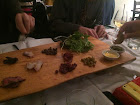
None of that last night. We decided to explore the native flavours of Australia. Bush Tucker is gaining in popularity as the modern Australian seeks to understand the culinary contribution of the original inhabitants on this island continent.  Tukka Restaurant (again in West End...see suburb profile week 23: Nepal) takes native bush food and turns it into international gourmet cuisine. In line with the discerning diner's desire to know what they are eating and where it comes from, the origin of each core ingredient is specified. We shared three Native Platters as an introduction to some of the more unusual ingredients: a selection of game meats (emu, crocodile and kangaroo) with fruits, nuts, damper (soda bread) and dips (lemon myrtle, mountain pepper, and bush tomato). For mains Keith had the pan fried gnocchi and bush tomato cream; Phil and Nielen ordered the Crispy skinned Tasmanian salmon served with a smoked celeriac puree, asparagus and a native tamarind butter sauce; Boetie chose the Seared Queensland kangaroo, fondant potato, baked rhubarb and a native hibiscus jus; Martina opted for the Marburg emu fillet, sweet potato and Tonka bean puree and cider braised nashi pear with an orange jus; Kerry had the Aniseed myrtle prawn tortellini, pickled vegetables with a lemon grass tomato broth  and I decided on the Crackling pork belly with pressed apples, watercress and an apple and muntries sauce. We could not resist the dessert - Deconstructed finger lime tart served with toasted meringue, vanilla sabla and house made lemon myrtle sherbet and a Cheese plate selection served with crostini, glacé quandongs and baby fruit. We all agreed - the food was exceptional. Bold and delicate flavours intricately balanced, beautifully presented with portions just the right size. True to Australia's reputation of being one of the most expensive countries in the world (third after Denmark and Switzerland), this was by far our most expensive meal to date.


Fact time: We started with some fun facts.... (Did you know that wombat poop is cube shaped? Did you know that the Australian Alps receive more snow than the Swiss Alps? And did you know that the world's longest mail run is from Cairns to Cape York (1450km)...the postman flies!)

......and then covered some history : The Commonwealth of Australia became a constitutional monarchy in 1901. Before then, Australia was divided into 6 self-governing British colonies, subject to British law. After federation, the colonies became States of the Federation of Australia. Yes, we are still very much attached to the hip of the British Monarchy.  Australia and Britain are separate nations, but sharing the same person (currently Queen Elizabeth the II) as our relevant sovereign.  I do not wish to get embroiled in a political debate, however, it does seem rather odd that our head of State is some 15,000 km away.  One would think that it is inevitable that Australia, too, will one day become a Republic.


Keith had too many facts to mention (amongst them the origin of Aussie Rules Football...designed to give cricketers something to play off-season), and I had to censor Kerry's fact.....


Of the seven of us around the table, only Kerry was born in Australia. Of the 23,1 million people in Australia, 25% were born overseas, representing over 200 nationalities. And it is for this very reason that we are able to embark on this tour of culinary diversity in our own backyard. Next week....Afghanistan.


Friday, 9 May 2014

Week 35: Indonesia

Week 35: De Gordel van Smaragden ( the belt of Emeralds)

The Dutch colonised Indonesia and occupied this volatile segment of the Pacific Ring of Fire for 300 years. All in the name of spice, however one could argue that establishing a strong military and political base in Asia could also have been a strong motivation for embarking on such a dangerous journey for some nutmeg and cloves....

Nevertheless, the Dutch controlled the Spice Route of the world and set up base in Batavia (today Jakarta) on the island of Java. It made them very wealthy, and Amsterdam overtook Venice as the richest capital in Europe. Indonesia is the world's largest archipelago with over 18,000 islands and hundreds of bubbling volcanoes.  The fertile valleys of deep, rich, layered volcanic ash and the equatorial climate allow for the bountiful production of food. It is often said that the soil is so nutrient-rich, that even the picket fence and the rattan lawn chairs sprout and grow.

Capitalising on these perfect cultivation conditions, the Dutch (struggling to cope without a decent cup of coffee in the morning) introduced Arabica coffee beans from Yemen to Indonesia and covered the island of Java with coffee, sugar and tea plantations. To protect their coffee industry, the Dutch legislated the kultuurstelsel  (culture system) in 1830, which prohibited the natives from drinking coffee (as it would corrupt their culture which up until then was coffee free, of course). The curious plantation workers, desperate to get a taste of this aromatic, coveted drink, observed that the civets, raiding the plantations for the coffee berry, only ate the fleshy pulp of the fruit, and left the seeds undigested in their droppings. So they collected the droppings, cleaned them, roasted and ground the beans to make their own brew. That was the birth of Kopi Luwak, the exotic and expensive coffee made form coffee beans egested by the Asian Palm Civet. If the beans are "wild sourced", they sell for over $700/kg, whereas "caged sourced" beans trade for around $100/kg. And in terms of taste?  The general consensus within the industry is that it just tastes bad!  This is definitely a case where you pay for the story, not the quality.

Over the centuries, many seafaring nations arrived in Indonesia and left behind profound cultural, religious and culinary influences. The Spanish brought chilies and peanuts from Mexico, the Chinese brought ginger and garlic, the Indians brought turmeric, cinnamon and coriander, the Dutch planted cauliflower, beans and carrots, and the Arabs brought the Muslim faith. Arab traders are responsible for the rooting of Islam in Indonesia, and today it is the most populous Muslim nation in the world.


No-one can compete with Indonesia when it comes to indigenous fruit: the hairy Rambutan, the fragrant Mangosteen, the star shaped Carambola and the unusual Durian (which looks like an oversized hand-grenade but detonates like a stink-bomb....No airline in the world will serve it, because of its unbearable smell. Indonesia has many regional cuisines, shaped by the different ethnic groups on the islands, but they all share 5 main cooking methods: 1) Goreng / frying, 2) Panggang/grilling, 3) Tumis/ stir frying, 4) Rebus/ boiling and 5) Kukus/ steaming. Rice is central to Indonesian culture ( they even have a Rice Goddess - Dewi Sri ), and is the staple for all classes. There is nasi uduk (rice cooked in coconut milk), nasi kuning (rice cooked in coconut milk with turmeric, or geelrijs), nasi ketupat  (steamed rice in coconut fronds) and lontong (rice steamed in banana leaves). Nasi Goreng is considered to be Indonesia's national dish, and that is exactly what I felt like eating last night.

The four of us visited the authentic Indonesian restaurant Jakarta in the suburb New Farm.  Situated on a large bend of the Brisbane River, the New Farm peninsula was originally a productive farming area (where convicts worked the land), a Marine Base in WWII, and a wharf, store and auction site for the wool clip form all over Queensland. Located 2km  south-east of the city, New Farm is the most densely populated suburb in Brisbane.  In the 1980's it had a drug-addled reputation, with a low-rent, grungy culture. Since then, gentrification kicked in, together with "infill development", and today it is one of the trendiest residential hotspots in the city.

Jakarta is sandwiched between an Indian and a Chinese Restaurant on busy Brunswick Street.  The décor is distinctly Indonesian, and so is the music. The tables are covered with original cotton Batik tablecloths from Indonesia and set with a fork for the left and spoon for the right hand. But the stand-out feature of the restaurant is the food (as it should be). All our meals were truly delicious ( Keith rates Jakarta in our top 10...which he insists we re-visit once the 52 weeks are over). We shared a variety of entrees ( lumpia sayur/pangsit goreng/bakwan udang and perkedel kentang). I then ordered the Nasi Goreng Istimewa, which was textbook perfect; Keith devoured his Gulai Kambing  - a traditional Indonesian style lamb curry which he raved about; Nielen had the Kari Ayam (chicken curry), and Phil enjoyed his Ikan Bumbu Bali - fish fillets in a Balinese sauce. In Indonesian cuisine, chili is hardly ever added to the dish, but rather served on the side as a sambal. This way you can fire up your food to personal preference. All the dishes were served with rice. They also offer the Dutch-Indonesian fusion Rijstafel  as a banquet, which illustrates the colonial opulence and diversity of Indonesian cuisine.

We discussed some fascinating facts while relishing the unique flavours of Indonesia: Most Indonesian men smoke, Phil told us, but 90%  smoke kreteks, which are clove spiced tobacco cigarettes. The creator of kreteks, Haji Jamhari suffered serious chest pains, and was rubbing clove oil on his chest to relieve the pain. He sought deeper relief, so in his wisdom, he added dried clove buds to his cigarette to inhale the curative magic of the spice. The story goes that his chest pain disappeared immediately.....

We also discussed the ill-fated maiden voyage of the VOC ship Batavia (1629) that ran aground on the Abrolhos Islands off the West Coast of Australia and the ensuing events which involved the extremes of human behaviour, both evil and heroic. If you are interested in history, this is a story well worth researching.

Indonesia is the 4th most populated country in the world (after China, India and the USA), with 230 million people. Migration to Australia started in the 1700's when seafarers traded sea cucumbers with the Aboriginals. In the 1800's many Indonesians came pearl-hunting off our west coast, or sought employment on the sugarcane plantations in north Queensland. In 1942, huge numbers fled the Japanese occupation as refugees, and in 1950 after independence, over 10,000 residents of the former Dutch colony with Dutch citizenship migrated to Australia. Today nearly 120,000 Indonesians call Australia home.

And now the time has come for us to celebrate our own......in joyful strains then let us sing: Advance Australia Fair ( in this case Australian Fare...). 


Saturday, 3 May 2014

Week 34: Eritrea

Week 34: Eritrea.


The camel is an amazing animal. Apart from being a beast that can carry an incredible burden (up to 500kg), it can kick in all four directions with all four legs,  can close its nostrils at will, can spit when feeling threatened ( or just because...),  and has a double row of long, curly eyelashes (no wonder the name camel stems from the Arabic word that means "beauty"). Camels have also played an invaluable part in many wars, and are to this day still used as a bartering currency. It therefor comes as no surprise that the camel is the national animal of 3 countries: Saudi Arabia, Kuwait and Eritrea.

Eritrea is strategically placed on the horn of Africa. The Italians colonised Eritrea in 1890, only to be expelled by the British in 1941, and then became federated with Ethiopia under an UN Mandate in 1951. After a protracted 30 year long war with Ethiopia, Eritrea finally gained independence in 1991 (which seriously annoyed Ethiopia, as it is now is a land-locked country, deprived of a port). So before we get to the food, let's discuss the facts ( see FNO rules week 1 blog): Eritrea is a one party State. Since independence, the country has never had a national election! There is no privately owned news media, and not a single foreign correspondent residing in the country. Independent news coverage has been banned since 2001.  Domestic and International Human Rights organisations are not allowed to operate inside Eritrea.  The nation's inability to grow enough food to feed it's people, widespread drought, landmines and economic progress being hampered by the proportion of Eritreans diverted from the workforce to the armed forces, are all factors that have led to many Eritreans seeking refuge in other countries. There are about 2500 Eritrean refugees in Australia, with roughly 210 living in Brisbane, most of them in Moorooka ( see suburb profile in blog week 3).


Last night , we had dinner at  Mu'ooz in West End, 2,5km west of the Brisbane CBD. Mu'ooz is a social enterprise to empower woman with limited education who seek refuge in Australia. The restaurant recently relocated from Moorooka to West End, offering refugee woman an opportunity in paid employment. Melkam Megeb!
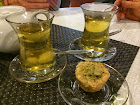
The cuisine of Eritrea is based around the produce that can be cultivated under challenging conditions. Lentils, rice, pumpkins, goat and lamb feature prominently. As in Ethiopia ( see blog week 3), the local flatbread called enjera replaces eating utensils, and is used to scoop up the delicious, spicy stews. We started our meal with a variety of vegetable "dips" accompanied by sourdough enjera and some Talmia  (chickpea fritters). For the main course we ordered 6 different dishes as part of a shared platter: traditional spicy beef curry, a tender lamb stew, a delicious dry chicken curry, a red lentil stew, mushroom and tomato braise and (my favourite of all) .... Duba ( a pumpkin curry). The portions were extremely generous, and we struggled to finish our banquet. Mu'ooz recently obtained a licence to serve alcohol, with South African wines featuring prominently. Should you wish to engage in the coffee ritual, set aside an additional hour to experience the roasting and brewing of coffee the Eritrean way.

We did share some other interesting facts as well: Eritrea is the first country in the world to declare its entire coastline (1,347km) and all its islands (350) an environmentally protected zone; Even though it is a country riddled with its own problems, Eritrea donated aid money to the Haiti Earthquake Relief Fund (however on closer scrutiny of this fact, I discovered that the money has never been transferred....)
 
Next week we shall explore the flavours of Indonesia. See you in Jakarta!