Friday, 7 February 2014

Week 24: Ireland

Week 24: The Emerald Isle


Former Australian Prime Minister, Bob Hawke, noted that  "apart from Ireland, Australia is more Irish than any other country", with 30% of Australia's population having some link to Irish ancestry. Between 1791 and 1867 more than 50,000 Irish convicts were sent to Australia, and during the Great Famine (1845 - 1850) diseased and impoverished Irish were shipped to the colony, amongst them 4,000 orphans. The 2013 immigration figures show that more Irish than ever before (42,000 from 2011 to 2013) are swapping the economic gloom of Ireland (still struggling to recover after the GFC) for the prosperous shores of Australia. Today over 2 million people (10% of our population) identify themselves as Irish, not Australian.

Centuries of social and political change shaped the Irish cuisine. The potato was introduced to Ireland in the 16th century. The temperate climate and fertile soils delivered healthy crops and became a reliable and affordable source of nutrition. As the base food for the poor, the devastation caused by the potato blight (destroying  two-thirds of the crop) led to the Gorta Mor 1845-1850 (directly translated "the great hunger" ) . This drew a dividing line in the historical narrative of the Irish. Over one million people died, and a further million emigrated, reducing the Irish population by more than 25%.

However, last night starvation was the last thing on our minds as we indulged in the pleasure of hearty pub food at Mick O'Malley's Irish Pub.  Before we were allowed entrance, the huge security guards at the door (could well have been one of the All Black props) asked for Boetie's ID ( still under 18....), but nevertheless let him enter with his very respectable looking parents! Flanked by the Hilton Hotel and the heritage listed Regent Cinema Palace on either side, I have often passed the big emerald green front door of Mick O'Malley's, but had absolutely no idea that behind the guarded entrance, deep in the catacombs of the Wintergarden Centre, lies a haven for those who subscribe to the subculture of pubbing. The place is huge, but because of all the structural support ( being underground), it resembles a maze. Clad in beautiful dark wood, with solid timber bar counters, and heavy furniture, it has a traditional pub feel: a stage with two guys singing Damien Rice songs(one playing the guitar, the other an electric violin), TV screens on every possible wall, screening recorded Irish rugby matches, framed sporting memorabilia, and every imaginable beer on tap! At the counter, we asked to open a tab for the night, which resulted in me having to hand over my credit card and driver's license in return for an ordering number.  I ordered a Tullamore Dew on ice, Boetie and Martina had something soft, Phil had a Guinness, and Keith, wanting to explore the subtleties of Irish Whiskey, was pointed in the direction of a dedicated whiskey bar in a separate room. This is where we eventually ended up having our dinner. As much as we enjoyed the renditions of Damien Rice, and the typical noise of pub-goers trying to make themselves heard over the music, the quieter Whiskey bar beckoned.

Irish whiskey used to be the most popular spirit in the world, but now there are only 7 distilleries left (as opposed to Scotland with 105). Irish whiskey has a much smoother palate structure, as they do not use peat in the malting process ( peat gives it that typical smoky/earthy character),  and it is pot distilled three times (the Scottish distil only twice). The knowledgeable Irish barman keenly shared his wisdom and passion, with Keith finally settling for the Redbreast 12 Year Old Irish Whiskey.  Redbreast is considered to be the quintessential example of premium Irish Whiskey, and the purest form of the art. (I have to admit, it had a beautiful rich complexity with an appealing hint of creaminess on the finish....might just have to go and get a bottle!)

To mitigate the effect of this delectable distillate,  we ordered Kilkenny Beer Battered Fish  with mushy peas, Bangers and Mash, Irish Stew, Steak and Guinness Pie and Stuffed Mushrooms. The portions were generous, and tasty...with only one disappointment: there were no mashed potatoes...... No mash! What is a banger without mash, I ask!

Nevertheless (honestly...no mash!), there were plenty of facts (see blogs week 1 and 19 regarding the rules for  Friday-night-out-Facts): Shannon Airport is the westernmost runway of Europe, and became an essential re-fuelling stop for transatlantic flights and in 1947, it introduced the first ever duty-free shopping; Ireland is a snake-free island; the national animals are the wolf-hound and the stag; the average height of an Irish man is 5"7; 90% of Irish are Catholic, and divorce was made legal only in 1992; and the origin of Irish Luck is unclear, except that it may relate to them having greater  success at staking a profitable claim during the gold rush era.

After Czechoslovakians, the Irish consume the most beer in the world, with 131 litres per person per year. So, one night, Mrs McMillen answers the door to see her husband's best friend standing on the doorstep,  "Hello Paddy, but where is my husband? Didn't he go with you to the beer factory?" Paddy nodded,  "Ah Mrs McMillen, there was a terrible accident. Your husband fell into  a vat of Guinness stout and drowned". Mrs McMillen starts to cry, "Oh, don't tell me that, did he at least go quickly?" Paddy shakes his head, "No, not really Mrs McMillen - he got out 3 times to pee!"


one more...


Billy stops Paddy in Dublin and asks for the quickest way to Cork,
Paddy says, "are you on foot or in a car?"
Billy says, "In a car."
Paddy says, "that's the quickest way."


Next week, we are off to Italy!

Friday, 31 January 2014

Week 23: Nepal

Week 23: Nepal...snow capped  mountains, yaks and yetis.

Nepal is  a small landlocked Hindu Kingdom, wedged between the high wall of the Himalayan Ranges and the dense jungles of the Indian plains. Since it opened its door to international tourists in the late 1950's, Nepal has become a trendy travel destination for intrepid Australian trekkers. It has some of the best hiking trails in the world, and eight of the highest mountains, including Mt Everest. "The Great Himalaya Trail" is Nepal's latest tourism product, and spans the country with 1,700km of trails. It is an alluring destination, not only for the adventure seeker, but also for those who wish to embark on a profound spiritual journey to the birthplace of Buddha. Lord Siddhartha Gautama Buddha was born over 2500 years ago (563BC to be exact) under a Bodhi tree in Lumbini . We, however, are on a culinary journey, which led us to a Nepalese restaurant named after this heritage listed place of religious significance, right in the middle of bustling West End, 1,9 km from the heart of Brisbane city. West End was so named by early British settlers who found the area reminiscent of the West End of London. We shall return to West End many times in the next couple of months, as it is a melting pot of culinary diversity, with multiple ethnic restaurants straddling the streets of this vibrant suburb.


Lumbini Nepalese Restaurant prides itself in serving authentic Nepali food. It is often said that you go to Nepal for the mountains, but you return for the people. If the friendliness and gentle manner of the staff at Lumbini is the bellwether for the nature of Nepal's people, then that is definitely true. There are just over 400 Nepalese living in Brisbane (17,000 in Australia), and at one stage, it felt as though all of them were hovering outside Lumbini. We were the only non-Nepalese diners, and when people started to get up and make speeches in Nepali, we knew we were caught up in more than just a regular Friday Night Out. Our waitress, a charming Nepalese student, explained that we were actually surrounded by celebrities: Stars from Nepal, performing at the Tivoli Theatre the following night, enjoying a welcoming function hosted by dignitaries of the Nepalese Association of Queensland.


Oblivious to the importance of our fellow diners, the eight of us started with a selection of  entrees. Masti Garna! They were absolutely delicious: Momo ( the unofficial national dish of Nepal - steamed pork dumplings with a spicy dipping sauce); Apple Chat ( stuffed vegetable puff with apple chutney served with raita and fried lentils); Poleko Khukuru (spicy grilled chicken served with yoghurt)  and my favourite, Aloo Chop (Himalayan spiced crunchy potato cakes served with tomato chutney). We placed the mains all in the centre of our long table and tasted a bit of everything:  Traditional Goat Curry; Lumbini Chicken Curry; Aloo tama Bodi ( slow cooked potatoes and beans with herbs and bamboo shoots); Beef Masala; Butheko Ginger (mixed mushrooms and vegetables) and Masu Bhat (a combination platter of beef curry, daal vegetables and roti). Phil ordered the Himalayan Briyani, which must have been served to one of the celebrities, as it never arrived at our table......not that we had a shortage of food to share! Taking a conservative approach, we ordered most of the curries as medium, however the heat of some of the dishes could have been amped up a little bit more. Being a neighbour to India, it comes as no surprise that most of the local cuisine is a variation on Indian themes. Malai Nepali khanna man parcha (I like Nepalese food).


Fact Time! The sharing of facts is starting to overshadow the importance of the food, and evolve into an amazing compendium of highly useful, extremely fascinating and completely irrelevant  information on the chosen destination. Last night alluded to the prospect that we might have a "spot-the-fake-fact" trend developing. One of the most interesting facts was that 90 % of the Nepalese population is Hindu. I wrongly assumed that most of them would be Buddhist. That also explains why the national animal is the cow, a fact Boetie shared with us, together with an analysis of the very unusually shaped flag. Keith pointed out that the bio-diversity of Nepal is second only to the Amazon forest, Martina's fact pertained to the geography of the mountains and Phil informed us that there are four different types of sign language in Nepal (at first I thought this might be a "spot-the-fake-fact" candidate, but apparently it is true). The Grevilles joined us last night, and did not disappoint in their fact contributions. Andrew had a long fact (expanding on the history of the Gurkha Soldiers); Finn had a short fact (the shortest man in the world at 57cm is from Nepal), and Louise had a topical fact (the production of textiles from wild nettles, de rigueur amongst the foremost Italian fashion houses).


Next week we'll try our luck in Ireland.


Nepal FlagThe Nepalese Flag, the world's only non-quadrilateral flag.


Aloo tama Bodi

Lumbini Chicken Curry


Masu Bhat


Beef Masala


Aloo ra Kauli

Friday, 24 January 2014

Week 22: Thailand


Week 22: Thailand...where eating alone brings bad luck.

Harmony is the guiding principle in Thai cuisine. The food is lightly prepared with strong aromatics. A balancing act between sweet, sour, spicy and salty, it is the juxtaposition of these taste profiles, together with the complexity of flavours that the Thai delight in. The dish Tom Yam Goong  summarises the aromas of Thailand best: lemongrass, lime leaves, galangal, shallots, chilies, fish sauce and fresh Thai basil. Other essential ingredients to have handy in the pantry (should you wish to whip up a quick Thai supper) include garlic, tamarind, coconut milk,  fresh mint and coriander. Substance to a dish is provided by fish or shellfish, meat or poultry and leafy greens, paired with steamed jasmine rice ( there are over 5000 different varieties of rice....clearly a staple.....to choose from) or noodles.
In Brisbane, we are spoilt for choice when it comes to Thai restaurants. They are everywhere, some  offering Thai cooking lessons (like Mon's Thai Rarnaharn in Windsor). Once exotic, Thai food now features prominently on the weekly menu in Aussie homes. Supermarket shelves are well stocked with the necessary ingredients, and just about everyone has a jar of Thai Green Curry paste in the fridge. And for the less adventurous cook, Thai take-aways offer a guilt-free fast-food alternative.

In Thailand, food is a social occasion. All dishes are shared and enjoyed together, and to eat alone is considered to bring bad luck. There were six of us sharing in the pleasures of Thai food last night. We visited Thai Ayuthaya in Kelvin Grove, 3km northwest of the CBD. The restaurant is named after the historic capital of Siam, Ayuthaya. From the 14th to the 17th centuries,  Ayuthaya was one of the world's largest and most cosmopolitan cities. Conveniently located equidistant between India and China, it acted as the centre of economics and trade in the East.  In 1767, the Burmese burnt the city to the ground.  Never rebuilt, today it is an important archaeological ruin and World Heritage listed site. The perfect city plan of Ayuthaya was used as template for the layout of Bangkok, the new capital. This perfect city plan may have worked in 1400, but today, Bangkok has some of the worst traffic issues in the world - they even have a medical team on permanent standby to deliver babies on congested motorways (Phil's fact...see blog week 1 and 19 regarding Friday Night Out rules).  The fact that Bangkok is the world's most visited city (ahead of London) obviously contributes to the road chaos.

We, on the other hand, had an easy drive to Kelvin Grove, named after the famous Kelvin Grove Park in Glasgow, Scotland, on the banks of the Kelvin River. True to Thai tradition, we ordered a banquet of dishes which filled the centre of the table - Gang Karee Gai (yellow curry), Pla Nueng Ma Now(steamed fish with lemon and Thai spices), Pad Med Ma Muang (stir fry with cashew nuts) and Gang Panang Curry. This allowed us to taste all the subtleties of the cuisine, however it was difficult to convince Boetie to share his Pad Thai  with the rest of us. Pad Thai is considered to be Thailand's calling card to the rest of the world: all the basic herbs and spices with noodles, beansprouts, coriander, onions and ground peanuts.  Gin Khoa! (eat well!)
We all agreed that we really enjoy this style of food. The enthusiastic use of fresh herbs and spices, the right amount of heat and the balance between salty, sweet and sour is a recipe for success. Even though we ate quite a substantial amount of food, no-one left the table feeling full, just comfortably satisfied.

Family-Friday-Night-Out would not be complete without the facts, and this week everyone remembered to do their research (unlike last week....) with free-facts aplenty! Nielen's fact also related to the tragic traffic situation in Bangkok: All traffic police wear facemasks as protection against the dangerous levels of pollution, with more than 20% of officers suffering some form of lung disease. One Thai bank estimated that the city's pollution woes add up to $2.3billion in lost production and health costs. Martina reminded us that Thailand has never been colonised (the British and the French agreed to keep Thailand as a neutral state between India and Vietnam to avoid conflict). Keith showed images of unexplained natural occurring fireballs that shoot out of the Mekong river. Boetie detailed the origin and meaning of the Thai flag and the national animal - the elephant. The elephant plays a very important role in Thai culture and history and acts as a symbol of royal power, peace, tradition, fortune and superstition. Their traditional participation in warfare often determined the ultimate winner, as was evident in the 300 year war between Burma and Thailand.  Elephants are highly intelligent and easily trained (can respond to more than 60 commands), and they love to play. Amongst their favourite games are tug-of-war, racing, and polo.

Fondly known as "the biggest" sport in the world, Ele Polo is the game of kings and dukes and people on the Forbes Rich list. Attracting sponsors of luxury goods like Piguet Swiss Watches and Mercedes Benz, the Elephant Polo World Cup of 2013 was held in Thailand. Participating countries included England, Scotland, Switzerland, India, Sri Lanka and.....our next destination....Nepal.


Friday, 17 January 2014

Week 21: The United States of America

Week 21: G'day USA!


O say does the Star-Spangled Banner yet wave o'er the land of the free and the home of the brave....
I reckon! The USA is the land of opportunity, where hard work is celebrated and success congratulated. A nation that oozes optimism and radiates confidence. A country that sets the pace, a pace that is frantically fast, and influences the way people prepare and eat food.

Food culture changes quickly, mirroring the times - nowhere more evident than in The States. The twentieth century was one of staggering transformation: The scientific approach to farming resulting in higher yields and more affordable food; Food processing in the 1910's (think Hellman's mayonnaise, Oreo cookies and Corn flakes...and don't forget the indestructible Spam, with a shelf-life of 7 years!) ; the invention of kitchen appliances (an essential in every post-war home kitchen); the introduction of frozen foods (the brainchild of Clarence Birdseye after a fishing trip); the opening of self-service supermarkets (which offered huge variety and abundance); the highway transportation network (which gave birth to McDonalds and the like, as pit-stop-road-side-dining on long haul journeys); Trans-Atlantic jet travel (which opened a whole new era of culinary awareness)...right up to the arrival of The World Wide Web.

When one thinks of American food, it's hotdogs, hamburgers and fries. True, but there is more than just the fast food culture. The re-settlement of millions of people from 1950 to 2000 introduced a pantry full of new foods and flavours - once exotic, now mainstream ( think Tex-Mex). The 1950's was the decade of "culinary kitsch" - processed food was the norm, and TV- dinners in alfoil trays substituted table-dining. One critic referred to the food trend of the 50's as "gastronomic debasement"!   In the 1960's Julia Child revolutionised home cooking with her unique and easy approach to French Cuisine. At the same time Jacqueline Kennedy appointed a French Chef to the White House kitchen. It wasn't long before every dinner party featured Coq au Vin and Boeuf Bourguignon. The late 60's witnessed the hippie-era, where a generation returned to nature and eschewed anything pre-packed. A trend to grow your own veggies, eat bean spouts, chew granola and make hummus started. Protest against the war in 'Nam, high inflation, free love and a long sleep-in resulted in the birth of "brunch"! The 70's focussed on fresh food, simply prepared.  The  80's saw unprecedented wealth creation, the height of consumerism, the introduction of platinum credit cards and the appearance of the Celebrity Chef . It was a decade of excess. Novelle Cuisine dominated - featuring oversized plates with miniscule portions of "something" - but diners where happy to pay more for less....till the Dow Jones crashed in 1987, which led to a yearning for comfort food. All that comfort led to excess weight, which the 90's had to deal with: enter a decade of personal trainers, treadmills, home gyms and reduced-fat-everything. Fusion cooking became the buzzword ( basically taking the healthier eating habits of Mediterranean and Asian cuisines and turning it local). Having said all that, we still ended up eating hotdogs, hamburgers and fries last night!
American-themed restaurants and pubs are becoming increasingly popular in Brisbane, and we had quite a choice: Lefty's Old Time Music Hall, Yard Bird, Tipplers Tap or Shady Palms. However,
we decided to make our first stop in 2014 at Carolina Kitchen in Coorparoo, an inner-eastern suburb, 4km from Brisbane City. Coorparoo is the Aboriginal name for Norman Creek that borders the west of the suburb, and translates into the place of the mosquito.....still over 14,000 choose to live here! Mike Perry, the owner of Carolina Kitchen moved to Australia from North Carolina and opened his suburban diner in 2010. He is one of 71,718 residents who declare they were born in The States, of which 6,057 live in Brisbane.

There is no mistaking that this is an American eatery. With buntings of the Stars and Stripes draped outside the entrance, posters of Michael Jordan and Louis Armstrong on the wall, and Dr Peppers Root Beer in the fridge, this is an all American affair.  Mike does not take reservations, so Martina, who arrived first, had to fight for a table in this very busy dine-in or take-out establishment. People are happy to queue for the Buffalo Wings with blue cheese dipping sauce, Aunt Lilly Mae's slow cooked BBQ Ribs served with southern potato salad, New York Fries (topped with chilli sauce, sour cream and grated cheese), Hamburgers, Hot Dogs and Hoagies.  Food for the Soul, says Mike, with southern jazz music playing in the background.  Trying to keep your waistline in check is not an option when eating at Carolina Kitchen. This is where you stop counting calories, and indulge in the naughty pleasure of eating fried and finger lickin' saucy food ...it does not happen every day!

Best we follow the clean food trend again next week, and take a trip to Thailand.


Friday, 6 December 2013

Week 20: Russia

Week 20:  Russia....so much more than Vladimir and Vodka.

What better way to end the week than to start the evening with flaming cocktails and  24 carat gold vodka shots?  If we were the same people who sailed the Turkish coast in1992 (see blog week 11) we may very well still be trying the over 20 different types of vodka on the shelf and grooving to the jazz band playing in the corner. However, given our remarkable sense of maturity, we managed to limit the shots and find a table furthest away from the brass section so we could actually have an audible conversation.  What has become of us?

So we went to Russia! Within our geographical confines (see rules week 1) we decided to visit Torba on Little Stanley Street. Torba is the brainchild of Anastasiya Sukhinina, a professional jazz singer who arrived here 2 years ago and now calls Brisbane home. Most of the 67,055 people of Russian descent in Australia live in Sydney and Melbourne, with some 10,000 settling in Brisbane. The successive waves of Russian immigration over the past 124 years were all for the same reasons: war and changes in socio-economic and political structures. It is estimated that roughly 170 Russians move to Australia every year and they positively contribute both professionally and culturally to the colourful Australian fabric.

The interior of Torba Restaurant and Bar is opulently designed with crystal chandeliers, copper wallpaper, gilded mirrors and plush velvet sofas. Purple and gold dominate the colour palette:  purple representing royalty and spiritual fulfilment, and gold symbolising prosperity, wisdom and luxury. With an impressive neon lit bar running along the back wall, the all female, young, blonde Russian waiting staff and the jazz band, the mood is far more nightclub than restaurant. Very modern Muscovite.

An ipad was placed on the corner of the our table which automatically scrolled through a pictorial representation of the menu. Prijatnovo appetite! It's all there: caviar and sourdough bread, Borscht, Blini's, Pelmeni's,  Ukrainian Pirogi's with pickles (and a beer), Moldavian Lamb Pilaf with pomegranate molasses, Golubci, Goulash,  Georgian Shashlik, and Belarussian Quail with buckwheat. We all enjoyed our meals, and even had room for dessert: Russian Cream Cake and Sour Cherry Roulette. A truly Russian affair.

There were seven of us last night: the usual 6 plus Heather, a visitor from London, who arrived fully prepared with two facts in hand (see rules week 1). There is so much to cover when discussing Russia. Being a nation famous for drink, food, friendship, music, literature and art, the topics varied from Faberge Eggs, The Bolshoi Ballet and Tolstoy to astronauts, war, law, extreme climate, The Two-Headed Eagle and left-handed polar bears. Free facts were flowing, and fun facts dominated the conversation ....like the Bubble Baba Challenge (an annual sex doll boat race on the Vouska River), to homeless dogs using the metro system to get around Moscow (and knowing when to get off because they recognise the station announcements).

Russia is a vast country, with its border longer than the distance from London to New York...and that is where we are heading next. The US of A! With the festive season upon us, and social commitments ramping up, we shall continue week 21 in January. Until then - Nostrovia!

Flaming cocktail

 and 24 carat gold Vodka

Blini's

Pilaf

Shashlik

Quail with Buckwheat

 Sour Cherry Roulette


Friday, 29 November 2013

Week 19: Morocco

Week 19: Morocco

Like an epaulette on the shoulder of Africa, Morocco proudly graces the north western corner of the continent.  It is a country with a rich history, a varied landscape and a refined cuisine. From the capital Rabat, to enchanting Marrakesh, and of course the famous Casablanca, Morocco is a destination on every traveller's bucket list. The Moroccan diaspora in Australia totals about 15,000. Our host last night, Ben, hails from Casablanca, Morocco's largest city.  He was a professional football player (a bit of a celebrity, in fact) before life through love brought him to Australia three years ago. And it is here, in his restaurant on George street, that we were charmed by both our host and the beguiling flavours of Moroccan cuisine.

This end of George Street is the legal precinct of Brisbane. Here the legal eagles and big wigs traverse the intersections from chamber to court. The architecturally impressive new Brisbane Supreme Court and Brisbane Magistrate Court bookend a beautiful grassed public square, with the Federal court just a block away. The appropriately named Ben's Alibi Restaurant is located right outside the steps to the Magistrate Court. The usual suspects were all there last night: Full House of Browns and Phil and Martina. After vigorous interrogation of the menu, we decided to start proceedings with a platter of dips and some hot Moroccan flatbread. No mediation was required, as four of us agreed to settle for two huge platters: The Moroccan Lamb and The Vegetarian Taste Plates. Boetie ordered a Moroccan Lamb Bocadillo with three dipping sauces, and Nielen had the Roast Moroccan Lamb pizza.  Prima facie, it was an impressive display of traditional Moroccan fare. Bismillah!

The taste profile of the food transports you to exotic places. Images of crowded souks and lonely deserts flash through your mind, aided by the atmosphere in the restaurant with its photographic murals and floating lanterns from the ceiling. The aromatics of saffron, mint, cinnamon, sumac, cumin, turmeric,  honey, sesame and pine nuts fill the air and translate into a combination of refined flavours on the platter. Moroccan cuisine is a product of its history: the diet of the original Berber people, the invasion of the Moors, the proximity of Spain and Portugal and the French occupation. Bordering both the Mediterranean and Atlantic Oceans, seafood is an obvious feature. Preserving olives and pickling lemons (a technique introduced by the Jewish Moors), the use of dates and figs and the essence of scented waters (especially rosewater) all add to the seductive appeal of this cuisine. We adjourned without even contemplating dessert.

Considering all the evidence before us, the only judgement that could possibly be passed was that we be found guilty of the crime of over-indulging, and sentenced to three days of fasting.

And while channelling the legal aura that surrounded us last night, a new rule relating to The Sharing of Facts was introduced ad hoc (see rules  blog week 1): Rule #7 : Should anyone present a False Fact , they will receive punishment yet to be finalised, without appeal. Please note that a False Fact ( a fact not researched properly and therefore incorrect and misleading) is indeed very different to a Fake Fact (deliberately made up...see Phil's fact  week 12), which is totally acceptable. Free Facts (any additional facts after the mandatory two facts have been delivered) are always welcomed and encouraged.

Having clarified the rules, Keith quoted Graham Nash in song with The Road to Marrakesh, Boetie fulfilled our expectation with an analysis of the flag and the national animal (the Barbary Lion, sadly now extinct); Phil made us aware that in Morocco, the path to true romance is through the liver, not the heart; Nielen informed us that the oldest university in the world is in Fes; I had to mention that not a single scene from the movie Casablanca was filmed in Morocco; and Martina....well, she is indeed guilty of providing a False Fact, which cannot be published.

Ben's Alibi is well worth a visit. Don't expect couscous and slow-cooked tagines, but rather food that can easily be eaten by hand, showcasing all the spices of this delectable cuisine.

Next week we are going to play it all again in Russia.


 mural inside Ben's Alibi

plates and bowls in kitchen

display of tagines

 Share Platter


 Our host Ben

Friday, 22 November 2013

Week 18: Japan

Week 18:  Nippon..... the Land of the Rising Sun


When one considers the options for Japanese cuisine, one could opt for the obvious..... like sushi, sashimi, tempura and teppanyaki . These styles of Japanese food are predictable and available in just about every suburb of Brisbane - from a quick and healthy sushi take-away for lunch, to the more elaborate, high-end representations at Sake or Sono in the city. And once you have witnessed the impressive knife skills and tricks of a Teppanyaki chef, it all becomes a bit more-of-the-same.

.....or you can have ramen. After extensive research, I managed to convince the family (and Phil) to take a 15 minutes trip south of the city to Sunnybank. It has taken nearly one hundred years, but Sunnybank has finally overtaken downtown Chinatown as home to Brisbane's largest Asian community. It is for good reason that it is referred to as Little Asia: nearly 40% of people living in Sunnybank do not speak English at home, and nearly 60% were not born in Australia.

Our destination was Market Square, the original site for the trading of poultry and fruit produced in this fertile parish in the mid 1800's. By 1950, it had given way to sprawling suburbia and local industry. Brisbane is home to 3,300 of the 40,968 Japanese resident in Australia (most migrated from Japan to work on the sugar cane farms in North-Queensland and the pearl industry in Broome (WA), and their cuisine has seamlessly integrated into modern Australian life.

Nagahama Ramen Hakataya is hidden in amongst a melee of Asian restaurants lining the Square. In fact, if you decide to go to Market Square for an authentic Asian meal, you would most likely not choose Hakataya Ramen, as you would walk straight past without knowing it's even there. The entrance is obscured by a yellow banner (I have no idea what was written on it), and to the right of the door are pictures of the fours dishes (yes, only 4!) served inside. The restaurant is no wider than a supermarket aisle, with wooden dining counters and stools on either side and an open view to the kitchen, with multiple gas burners and gigantic stock pots.

So what is ramen? Essentially, it is a Japanese noodle soup (ramen means "hand-pulled noodles"), built around a pork stock (tonkotsu), simmered for 38 hours, skimming off all impurities. The result is a clear, mildly flavoured, collagen rich base, which is then seasoned with soy, miso, nori (seaweed), kamaboku, sesame and green onions. This is topped with Char Siu (prime pork belly, slow cooked in a special sauce at a low temperature for nearly three hours and then chilled for 2 days to seal in the juices). The noodles are made from wheat (not rice flour), and can be thick, thin, straight or wrinkled. So one could easily be forgiven for calling  Hakataya Ramen a soup kitchen.  There were only four of us last night (me, Keith, Boetie and Phil....Nielen again missing in action somewhere), so ordering was easy: one of each please! Douzo meshiagare!  (please enjoy your meal!)

From the moment you enter, you feel welcome, with staff chorusing irashaimase  (come on in!) as you walk through the door. Service is swift and friendly, and aprons to protect your clothing from potential splatter are available on request. Noodles and toppings are eaten with chopsticks, and it is perfectly acceptable to raise your bowl to your mouth to drink the soup (however, spoons are available).

I had the Miso Spicy-Men, and dare I say, this was my favourite meal on our 17 week journey so far. The stock had a layered complexity of flavours unfamiliar to my palate, the seasoning was beautifully fused with the subtlety of the soup, the pork belly literally melted in my mouth, the noodles were perfectly cooked, and the crispy nori topping added a textural balance. I simply loved eating this meal. It was truly delicious. Afterwards we wandered through the square, watching hundreds of locals dining in the packed restaurants and toasting the end of another working week. We concluded the evening with an ice cream cone (flavour options included Black Sesame, Jackfruit, Green tea and Durian) and a shot of espresso which we bought from a 10 year old boy at a local vendor.

We had some great facts last night: from koi to kamikaze, and samurai warriors to sumo wrestlers......all fascinating stuff.  However, Phil's fact on "Paris Syndrome" (which I researched and is absolutely accurate...not like his fake fact on China - see blog week 12) was the most fascinating of all: Each year, dozens of Japanese contract "Paris Syndrome" while visiting the French Capital. Apparently the contrast between the rude reality and the romantic expectation is such a cultural shock to the polite, soft-spoken and helpful Japanese, that they suffer a psychiatric breakdown, and have to be repatriated to their homeland by the local embassy.

If you wish to visit Hakataya Ramen, be advised that they do not take bookings, and due to its popularity, you may have to queue for a short while...but trust me, it is well worth the wait.

Next week, our journey continues from the Land of the Rising Sun, to the Land of the Rolling Dunes. See you in Morocco.

The impressive stock pots

entrance

Behind the banner

the four ramen

Absolutely delicious


Friday, 15 November 2013

Week 17: Brazil

Week 17: Brazil


There is something irresistible about the aroma and flavours of char-grilled meat, cooked over an open fire. The barbecue takes on many forms: The South Africans love their Braaivleis, here in Australia everyone enjoys a Barbie, and in Brazil, they celebrate all things meat with the 300 year old Churrasco tradition. With churrasco (pronounce shoo-has-co), large cuts of seasoned meat are cooked on slow rotating skewers over hot charcoal. This allows the meat to gain an even smoky seal on the outside, while trapping all the natural juices inside and keeping the meat tender. Once cooked, the waiters walk through the restaurant and carve the simmering meat at the table onto the diner's plate (a service style referred to as rodizio).

The churrasco method is still the most popular way to cook meat in Brazil. We did not need a passport to experience this tradition. We merely travelled 6 km to the west of the city to Bardon, a quiet and leafy suburb on the foothills of  Mt Coot-tha. Residents of Bardon generally have a healthy bank balance, are professional, own a bicycle and a bit of lycra. It is here that we discovered Mundo Churrasco, Brisbane's own little bit of Brazil.  There are 7490 Brazilians in Australia, with 670 living in Brisbane, most of them students seeking to improve their English.

Our friends Phil, Martina, Steve and Persephone arrived, and we kicked off the evening with a round of the traditional cocktail Caipirinha, which has Brazil's national spirit cachaqa (fermented sugar cane juice) as the base. At the same time, we received a bowl of fried bananas dusted with cinnamon sugar and some cheese bread. The friendly waitress (clearly here to improve her English) explained the service and suggested a variety of sauces to accompany the meat. And then it began......beef rump, chicken thighs, pork belly, leg of lamb - name a part of the anatomy and it was served...even chicken hearts were available on request. Bom apetite! (yes...it is bom)

We ordered a bottle of  Bodega Zapata Alamos Malbec from Argentina, which perfectly complemented the meal. It was full and rich (big enough to cope with the rock salt on the rump, the peri-peri on the chicken, the honey-lime-mint on  the lamb and the paw-paw sauce on the pork belly) yet a hint of chocolate and the sweet spiciness of the American oak were evident. Also on the table were bowls of potato salad, tomato and onion vinagrete and a green salad with kiss peppers. There were sausages, grilled vegetables, caramelised pineapple and more, which we eventually had to turn away. This was achieved by turning the little wooden block placed in front of each diner upside down to expose the red side. If the green side stays on top, the food will simply keep on coming! Our protein quota for the year has well and truly been exhausted. We did leave room for dessert this time:  Passionfruit and salted caramel mousse with tropical fruit and burnt marshmallows, and Churros (South-American donuts served with cream and chocolate dipping sauce). In summary, the meats were all truly delicious, the accompaniments adequate and the dessert completely unnecessary. Dining at Mundo Churrasco is an experience well worth having.

The facts (see blog week 1), again, were fascinating. As Boetie was absent, Keith gave us a run-down on the flag (quite a long story...) and the three national animals ( the Jaguar, Macau and Rufous-bellied Thrush).
When Nielen thinks of Brazil, he thinks of their five time World Cup Winning football team.
When Keith thinks of Brazil, he thinks coffee (Brazil supplies 25% of the world's coffee).
When Phil thinks of Brazil, he longs for the congestion free 16 lane highway in the capital Brasilia.  When Persephone thinks of Brazil, she recalls her gap year travelling through South-America and the powerful image of the Christ The Redeemer statue on Mt Corcovado in Rio. When Steve thinks of Brazil, he thinks 200 million heads of cattle (one for every person in the country). When Martina thinks of Brazil, it's the Amazon Rainforest, home to one third of all forms of life on earth and the destruction thereof through deforestation.

And when I think of Brazil, I think PARTYYYYY! The Rio Carnival started in 1641 with masquerade balls. In the 1800's the elite started to parade the streets in their amazing masquerade ball gowns, accompanied by military bands, and from there it evolved into a full blown festival, with the focus on dance. Today it is essentially a Samba Dance-Off  between the over 200 different Samba Dance Schools (4000 people per entry).....a Parade Extravaganza like nowhere in the world! The traditional masquerade balls are still held at the Copacabana Palace and the more exclusive Banda de Ipanema.

But for now, the party is over and we have to grind away another week before we can celebrate all things Japanese.  
 

The churrasquiera

 Picanha

 Linguica
 
 
 Mundo Summer Plate

Friday, 8 November 2013

Week 16: Sudan

Week 16: Sudan

I am not going to mention poverty, drought and starvation. Nor unemployment, high inflation and corruption. I shall not discuss disease, malnutrition and infection.  And forget about genocide in Dafur and the fact that Sudan is considered to have "The most repressive regime in the world". Let's put all of that aside, and for now, focus on some of the warmest and most hospitable people in Africa. Where it is common to be invited into someone's home to share a meal, or have a glass (or 5) of tea.

Last night, it felt exactly that way. Essentially, we were welcomed into Hamar's dining room, and overwhelmed by his hospitality and joy in serving us food from his native Sudan. Hamar arrived in Australia 18 years ago, taught himself how to cook, and opened Umdorman Cafe in Moorooka (see week 3 blog: Ethiopia for suburb profile). Through the Australian Humanitarian Programme and the UNHCR,  Australia has given 19,050 people from war-torn Sudan a new home and a second chance. Moorooka is often called "Little Africa", or "Africa Town" and evolved to reflect the profile of its demographic, with most of Brisbane's 1,805 Sudanese residents settling in this suburb.

Being the hub of African refugee re-settlement, it was not surprising to be the only Caucasians in the restaurant. Umdorman is clearly popular with the local Sudanese community, many gathering there after work to watch the ABC World News on the wall mounted television, and enjoying a hearty, familiar meal. Our arrival must have disrupted their usual Friday night routine, as the regulars inconspicuously left the room, one by one, and continued their gathering outside on the pavement. Soon we were the only people in the restaurant, and had our own private banquet!

Bil-hana' wa ash-shifa! (enjoy your meal)

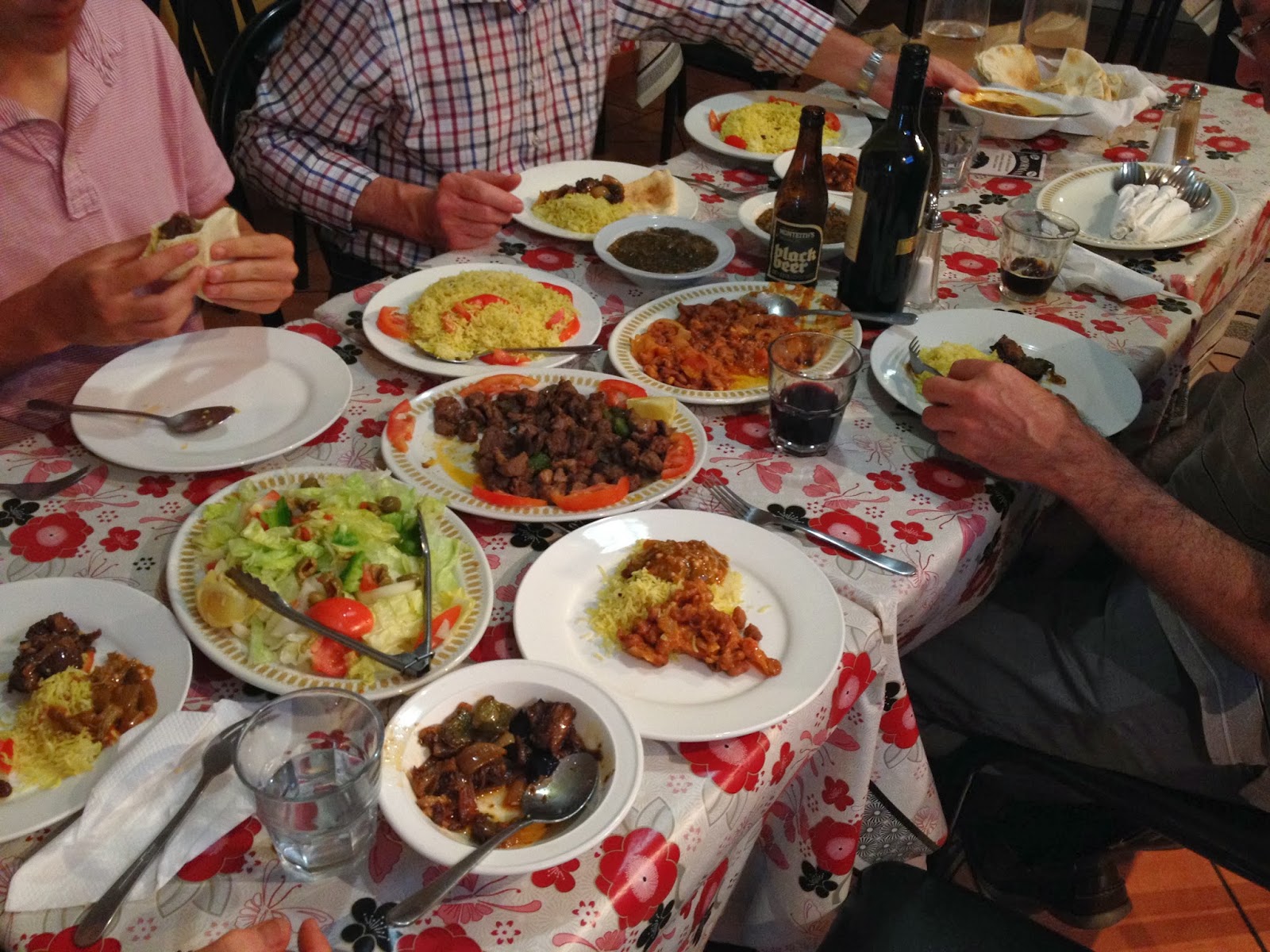
 At Umdorman, one would usually order from the array of dishes in the bain marie  at the kitchen counter. Hamar would have none of that, and insisted on serving us at the table. He arrived with two dishes: Gewerma (a traditional diced lamb dish with onions) and Kebab Tawa (a local favourite lamb dish with beans) and two huge plates of rice. The flavours were subtle, and the lamb cooked beautifully tender. Halfway through, he arrived with two more dishes: Bamia (an okra stew) and Molokhia (similar to spinach, but with a slippery consistency) and more rice. By now the table was laden with food, but that did not stop our host from bringing three more dishes: Kebab Hallah (lamb curry), a delicious eggplant braise, with onions and capsicums accompanied by some flat bread (kisra) and a lentil stew. Noticing the Gewerma bowl was empty, he quickly replaced it with a full one. The evening reminds me of  Sunday lunch at my parent's place, where the food just keeps on coming, and the end is never in sight. We thoroughly enjoyed being there, yet again in an environment far removed from the glam of the designer dining in the city. The food is honest and simple, tasty and healthy. Umdorman is a Halal establishment, which implies that serving alcohol is forbidden. I was therefore reluctant to take a bottle of wine and being served 40 lashes (the penalty for consuming alcohol under Sharia Law) instead of a meal, but fortunately this is Australia, where Sharia Law does not apply, and Hamar was more than happy for us to have wine and beer at his table.

Nielen formulated a new rule a couple of weeks ago (for rules see week 1 blog): Rule 6 - The sharing of facts can only commence once food is served. As he himself broke the "obligatory attendance" rule last night, we disregarded his new rule, and pretty much started babbling about Sudan the moment we sat down. Phil and Martina, our ever faithful accomplices, contributed with ardent enthusiasm. Man has lived in Sudan for at least 30,000 years, and the valley of the Nile is often referred to as the "Cradle of Civilisation". Situated in Northeast Africa, Sudan is the largest country on the African continent (if you include the recently independent republic of South-Sudan), with a vast flat desert and vicious sandstorms to the north, and a mountainous sub-tropical region to the south. Umdorman is one of three sister-cities located at the confluence of the Blue and White Nile rivers.  Home to the largest market in Sudan (The Soug...a vibrant and lively destination for shoppers) Umdorman is the youngest city of the three, built on the northwest bank across the White Nile, with the capital Khartoum situated on the south bank of the Blue Nile. The centre of Khartoum is a clear remnant of the British Empire, with the street plan laid out in the shape of the Union Jack, resulting in terrible gridlock all day long.

Being a remnant of the British Empire is about the only thing we have in common with Sudan. It is difficult to find a country where the British did not leave their mark...which leads us to our next stop...untainted by interference from The Empire: Brazil!


Local resident outside Umdorman

 Every day fare

 and that's not all of it yet...!

 we did well.

Friday, 1 November 2013

Week 15: Vietnam

Week 15: Viet Nam

When discussing Viet Nam, the conversation either starts with or will inevitably lead to the war. In 1965 Australia committed their first combat troops to South Vietnam, to help stem the spread of communism in Europe and Asia. Over 60 000 Australian soldiers did battle, and 521 died during the eventual 13 year conflict. Nearly 50% of the Vietnamese population was internally displaced, and millions were killed. As a result, there were over 800 000 orphans, and after the fall of Saigon, Australia adopted hundreds of orphans and started to accept refugees. This was the first group of Asian immigrants to settle in Australia since the White Australia Policy was abolished in 1973. Today there are 221,114 Vietnamese resident in Australia, of which 21,416 live in Brisbane.

We are fortunate to have the full spectrum of Vietnamese Cuisine in Brisbane: from upscale French-fusion to really basic take-aways. Last night, our adventure led us to Darra, a suburb 14 km west of the CBD. Darra, one of the older suburbs in Brisbane, is the epicentre of the Vietnamese community (18% of the residents in Darra are Vietnamese). I thought it might be prudent to do a recce before dragging family and friends into the unknown. This vibrant little retail precinct could well be somewhere in Hanoi with all the shopfronts signed in Vietnamese: the Vietnamese bakery, Vietnamese seafood market, Vietnamese laundry, newsagents and cafes. After inspecting several eateries down the main strip, I noticed a restaurant hidden at the back of a laneway opposite the train station. With one-way mirrored windows, I had no idea what to expect on the other side. To the left of the restaurant was a room filled with elderly men playing cards, sitting on inverted milk crates, cigarette smoke billowing through the open door, and to the right is Salon Kim, next door to Trang Video. It was about noon on a Tuesday morning. I pushed the door open, and was surprised to find a packed restaurant, humming with the sound of chatter and chopsticks. Scanning the meals on the tables, and sneakily observing the activity in the kitchen, I considered my reconnaissance mission successfully completed.

Vietnamese cuisine is light, refreshing, and deliciously satisfying - ideal for the warmer months. The fundamental features of the cuisine include an abundance of aromatic herbs, fresh seafood and vegetables, rice noodles and rice paper wraps, soup-based dishes and the long-standing French influence. It is considered to be one of the healthiest cuisines in the world, as the emphasis is on freshness, and nothing is cooked in animal fat. The objective of a meal's composition is to create a balance that is beneficial to the body. It centres around five elements: wood (sour) , fire (bitter), earth (sweet), metal (spicy) and water (salty).  And they all came into perfect alignment on Friday night at Nha Hang Thanh Quyen. Here we go: an ngon nhe!

Discovering Nha Hang Thanh Quyen was like winning the Lotto. The food was everything the theory promised. It was fresh and delicious and satisfying and incredibly reasonable. There were nine of us last night (if this was an Arlo Guthrie song, we would have classified as a movement!). This family owned restaurant was full, and there must have been at least two table rotations while we were there. We had a fabulous meal. Thank goodness the menu had English subtitles, but we nevertheless ordered by number. Everyone had a different number, and everyone was happy: Noodles with prawns and pork; vermicelli with spring rolls and sugar cane prawn cakes; rice vermicelli with duck and young bamboo; a delicious starch broth with pork hock and fish cakes;  noodle and mussels soup with coriander and sprouts; chilli and lemongrass chicken with rice;  and roll-your -own rice paper rolls with prawn, mint, bean sprouts, cucumber, crisp lettuce and grilled pork. It's BYO, cash only and closes at 9pm. We were the last patrons to leave, with Mr Quyen waiting at the door to lock up. This humble eatery must be one of Brisbane's best kept secrets.  

Tonight, the Gold Lotto has rolled over to $22 million. I have marked six of the nine numbers from the dishes we ordered last night as my Lotto entry: 35, 40, 41, 38, 39 and 44.......you never know your luck!

Again, we shared many interesting facts......the flag (red with one big golden star, of which the 5 points represent the 5 groups of people: the intellectuals, the military, farmers, businessman and the workers)  the national animal (water buffalo), the geography (Vietnam will fit between Brisbane and Melbourne).....and of course The War.
Homework for week 16: Find Facts on Sudan.


61


38

35

71

39