Friday, 25 October 2013

Week 14: Lebanon

Week 14: Lebanon.....the place of lavish hospitality and fine food

If you were a student of wine, you would know that it all started in Lebanon.  The oldest vineyards in the world were planted in the land of Canaan, the coastal strip of today's Lebanon. It was the Phoenicians who introduced the Mediterranean to wine and viticulture; it was the wines of Byblos that graced the tables of the ancient Pharaohs of Egypt in 2686 BC; and it was here in Lebanon that Jesus performed his first miracle, of turning water into wine.

Today there are 35 wineries in the hauntingly beautiful Bekaa Valley. My favourite winery from this region is Chateau Musar, 20km north of Beirut. The vineyards are high up on the slopes of Mount Lebanon, beyond the opium fields. During the 1989 civil war, the winery's underground wine cellar doubled-up as a bomb shelter. The owner, Serge Hochar, recalled staring at heavily armed Hezbollah fighters, and ducking bullets and rockets to harvest his Cabernet Sauvignon at optimum ripeness. Serge famously said: "Good wine should be dangerously attractive. What I want, is a wine that troubles me". Oz Clarke, top wine author, renowned for his wine tasting ability wrote: "Every time I taste Chateau Musar, one flavour consistently outweighs all the others put together. Courage."
I couldn't agree more.

Our friend Phil's fact for the night (see blog week 1 regarding Friday Night Out rules) - more of an insight than a fact, really - reflects our collective summary of Lebanon: It is a complicated place......

And at the heart of this complication, lies passion. Passion for life, for family, for food, wine and tradition. And this passion translates into the cuisine. This part of the world is known as The Levant, or Eastern Mediterranean. The Levantine cuisine was shaped by the Ottoman Empire, and all the countries between Turkey and Egypt share the distinctive culinary aspect of mezze. These include an array of small dishes of different colours, textures and aromas, like stuffed vine leaves, tabouleh, fattoush, humus, baba ghanoush and kebbeh (Lebanon's national dish). Lebanese flatbread is a staple, and often replaces the fork. Eating is considered a social event, and sharing food with family and friends is central to Lebanese culture, so last night we visited Rouj (red)  for an authentic Lebanese experience.

You will find Rouj  3km west of the city in Brisbane's smallest suburb, Rosalie. In fact, Rosalie is so small, that Council decided it no longer qualifies as a suburb, and re-classified it as a locality. In 1864, this distinctive little village was known as Oxford Estate, but residents started to call it Rosalie, after a name painted on the side of a local bus that passed through daily. Who Rosalie was is a mystery, and her identity may be lost, but her name lives on in this boutique suburb.

Rosalie was one of the worst affected areas during Brisbane's devastating floods of January 2011. Newspaper headlines read: Rosalie going Under, and  Inner City Suburb Rosalie fast disappearing. Rouj was one of the many restaurants in Rosalie that was completely wrecked by the floods. But owner Sodith Aoude, who moved to Australia in 1988, rebuilt Rouj, and today it is a vibrant establishment that celebrates classic Lebanese recipes. She cooks traditional dishes, staying true to the rich flavours of this Mediterranean cuisine, using lots of lemon juice, garlic and fresh herbs.

Without further ado: Sahtein!

We were treated to an assortment of mezze to start with, of which my favourite was the cooked green almonds with fresh coriander, garlic, lemon juice and olive oil. The mains included a Shwarma Platter, Mansaf ( slow cooked lamb with rice, tabouleh, fragrant rice, nuts and caramelised onions), Moghrabieh ( lamb spiced with cumin, caraway and cinnamon, served with chickpeas and Lebanese couscous), lamb shish and haloumi kafta with tahini sauce and labneh, and a vegetarian dish of pumpkin kebbeh and ftayer served with mjadra, tzaziki and Lebanese bread. We ended the meal with Lebanese coffee accompanied by baklava and Turkish delight.  Everything was delightful!

So, the trivia: Boetie, our flag-and-national-animal man, managed to give us a run-down on the flag, but came up short with the national animal......Google, Wikipedia, Yahoo, Ask.com.....no-one can tell us what the national animal of Lebanon is. If you have the answer, please let us know. Nielen, our resident uni-student, informed us that the first Law School in the world was built in Beirut and that Lebanon has no less than 42 universities. Martina had facts on the age of Lebanon (oldest nation in the world at 4000 yrs), and its biblical connections (mentioned 75 times in the Bible). Keith took us into a maze of caves to see the world's longest stalactite (8.2m). And Phil was still pondering on the complications of the place.......

There are roughly 200,000 Lebanese living in Australia. The majority are Maronite Christians, congregating in the western suburbs of Sydney, and engaging in their rich cultural heritage of lavish hospitality and fine food.

Next week we shall travel further east, and test the hospitality of Vietnam.


Mansaf

 Vegetarian platter

Moghrabieh

shish and kafta

Lebanese Coffee

Friday, 18 October 2013

Week 13: Belgium

Week  13: Belgium....the quality of  France and the quantity of Germany

It rained yesterday! A huge downpour. For the first time in about three months, the heavens smiled upon our dying gardens. But heavy rain is usually accompanied by traffic chaos. Driving back into the CBD on a Friday night in absolute gridlock was a frustrating exercise and I cursed our decision to reserve a table for the 6pm sitting at The Belgian Beer Café.

My patience was rewarded with a parking spot right outside the entrance. The Belgian Beer Café is located in a heritage listed building on the corner of Edward and Mary Street, constructed in 1887. During that time, this end of town became a warehouse district, conveniently close to the wharves on the Brisbane River, and this beautiful building was then filled from floor to ceiling with handmade boots.  Today, this magnificently restored storage facility is filled with the smell of beer and the sound of laughter. The bar section was buzzing with suited businessmen discussing the US debt debacle and the Google share price whilst savouring their favourite beer on tap.  The beer menu is extensive: from Artisan and Trappiste, to Blonde and Brune....something for every taste. The beer is served in chilled traditional beer glasses, quite different to the German shapes, as most of them have stems.

However, The Belgian Beer Cafe is not just about the theatre of beer. The Belgian national dish is Moules-frites (the fried potato chip is actually a 17th century Belgian invention, and they eat it with mayonnaise not ketchup). The mussels are served in traditional steaming pots, and there are four options : Provencale (with olives, tomato, chilli and basil), Mariniere (white wine, bay leaves and persillade), Roquefort ( with blue cheese, chardonnay, cream and baby spinach) and Norwegian (creamy veloute, smoked salmon, white wine and mushrooms). Keith, Lani and Boetie tried a variation each. It is difficult to describe the taste of mussels: sweet, fluffy, sea-salty but never fishy is the best I can offer. If you are not a fan of this delectable bivalve (often referred to as the poor man's shellfish)  there are many other dishes on the menu. I had the duck, Nielen ordered risotto with spring peas, cavola nero, mint and shaved parmesan, Vanessa had a fillet of perfectly grilled snapper with mashed potatoes, a Mediterranean salsa (similar to pesto, but without the pine nuts) and apple cider beurre blanc, and Sophie chose the organic beef eye fillet with frites, béarnaise and red wine jus. I have to admit, the food far exceeded our expectations. It was well presented and deliciously prepared.

After beer, the second most important food group in Belgium must be chocolates. The history of chocolate begins in the South American Jungle, and huge gratitude should be bestowed on the Spanish explorers for introducing the cacao bean to Belgium during their rule in the 17th century. When the Belgians colonised the Congo in 1885, they stumbled across an unlimited supply of  stronger, more assertive cacao beans, which led to an annual production of over 220,000 tons of Belgian chocolate today. So, needless to say, we ended the meal with traditional Belgian waffles and dark chocolate sauce with hazelnut, pistachio and caramel ice cream.

Dark chocolate has many health benefits.  It lowers blood pressure, lowers LDL cholesterol, improves memory and acts as a natural anti-depressant as it stimulates the release of endorphins to produce a feeling of happiness and pleasure. I can testify that this is true, as the stress of driving to the city centre in mangled traffic on a Friday night was replaced with a feeling of happiness and pleasure, after indulging in a jug of silky smooth dark chocolate sauce.

Discussing all things Belgian, it would be remiss of me not to mention Tintin (the heroic reporter who together with his four-legged companion Snowy, get involved in dangerous situations and eventually save the day) or the Smurfs ( the tiny blue-skinned humanoids, who live in mushrooms, eat sarsaparilla leaves and wear Phrygian caps, which represent freedom), both created by Belgian comic book artists. My childhood would have been so much poorer without these characters to escape with.

Listening to Gotye (our very own Grammy winning Belgian-born Australian.....one of 5,762 living here) on the way home completed a most enjoyable Belgian experience.

Next week, we travel to Lebanon.


The heritage listed building, home to the Belgian Beer Café, Mary Street Brisbane


Mussels

 Grilled Snapper

 Confit Duck

 Steak and frites

 Risotto

 Best frites ever!
 
 Belgian Waffles and chocolate sauce.

Friday, 11 October 2013

Week 12: The People's Republic of China

Week 12:  China..... it's all about the Yin and the Yang


Chinese cuisine has an incredibly long history of development and diversity. Each  Dynasty contributed to the evolution of food preparation, until the art of culinary excellence
peaked during the Qing Dynasty (1644 - 1911). Intertwined with the love of food, is the basic philosophy of harmony, balance and duality of existence. Essentially, this can be translated into the blending of contrasts, or Yin and Yang.

Contrasts in taste and texture, colour and cooking method, hot and cold, plain and spicy all contribute to a balanced meal - a triumph of philosophical theory. To gather more insight into this cuisine - one that strives for the perfection of all senses - I referred to some of my long forgotten Chinese recipe books, covered in dust amongst all the modern day "celebrity chef "cookbooks in my library. It did make me re-think the significance of sweet and sour, fried versus steamed and the contrasting flavours of ginger and spring onions, the foundation of most stirfries. 

Brisbane has it's own Chinatown. This is a significant landmark and recognisable precinct for Chinese cultural activities. The street names are all signed in Chinese and the roads are flanked by  Chinese supermarkets, yum cha palaces and traditional herbalists. There are 69,343 Chinese living in Brisbane ( 866,205 in Australia....excluding all the international students studying on temporary visas), and today mainland China is the largest source of migrants to Australia, overtaking the United Kingdom.

We decided not to go to downtown Chinatown, but rather visit a popular Chinese restaurant on Grey Street in South Brisbane. I am glad we had a reservation, as it was packed, and the queue outside was about forty deep. The kitchen is a central glass cube, through which one can witness the numerous chefs hand-tearing noodles, steaming the dim sims and displaying their impressive knife skills.

There are many ways of saying bon appetite in Chinese. Take your pick: Zhu Nihao Wei! Ge Bao! Ging Man Yong! or Sihk Faahn!

Unlike any of the previous weeks, I approached China with unprecedented philosophical expectation.
And sadly, I was hugely disappointed. Not even the intervention of the Blue Dragon, the Red Phoenix, the White Tiger of the Dark Turtle could bring back the Friday night Feng Shui. 

It could have been a case of overpromising and under- delivering, or that we were just too tired after a very busy week, or (most likely) that Martina's depressing facts about the air pollution, water degradation and waste generation simply dampened our spirits. But my meal was more yang than yin, which led to a night of interrupted sleep, as I frequently reached for the glass of water on my bedside table. Where my soup was too salty, Keith's stirfry was too bland. Boetie enjoyed his crispy duck, Nielen and Phil both had Sweet and Sour Pork, and Martina is still questioning her vegetatrian choice.  The service was over efficient, and I ( a slow, measured eater) ended up being the only one with food in front of me, as the others' plates were cleared away the moment the chopsticks hit the table. Speaking of chopsticks (another depressing fact): 45 billion pairs of wooden chopsticks are produced in China annually. This equates to the loss of 25 million fully grown trees every year.  Chopsticks were only introduced as an eating utensil during the Ming Dynasty, when it was the imperial fashion to have food prepared in bite-size portions.  It is also rumoured that Confucius, in his wisdom, declared that there should never be a knife on a dining table.

True to "Friday Night Out" tradition the trivia is always a highlight: Boetie enlightened us on the    interpretation of the Chinese flag and the national animal (the giant panda);  Nielen pointed out that one in every 5 people on the planet is Chinese; Keith (again with visual device in hand) scrolled back  4000 years on a histomap, and Phil had the most entertaining fact about all Chinese jumping simultaneously and causing a tsunami to devastate the west coast of America, but later confessed that he made it up! He redeemed himself by quoting from his databank of Chinese Wisdoms.

Hopefully we can regain the balance between  yin and yang next week, as we take a trip to Belgium!


Friday, 4 October 2013

Week 11: Turkey

Week 11:  Turkey....Veni Vidi Vici

In 1992, six of us charted a yacht and sailed the south-western coast of Turkey. I often refer to it as our Peter Stuyvesant holiday....remember those amazing cinema ads with that very distinctive jingle, depicting an idyllic lifestyle?  That was us...for two weeks at least. We did not have a care in the world, and because of that, I saw the world in cinemascope - the beaches were whiter, the sky was brighter, the ocean more turquoise and the tomatoes tasted sweeter.  I couldn't get over the flavour and colour of the tomatoes (in hindsight, I believe they were so good because they never saw the inside of a fridge!) We sailed to remote locations, explored rural settlements and enjoyed their local produce. Language was often a barrier, so-much-so that the owner of a tiny eatery in Gocek actually invited us into his kitchen to prepare our own meal, as he couldn't understand what we were trying to order. And I can still smell the wafting aroma of freshly baked borek, with spinach and goat's cheese filling, that we bought from a local woman on the quay of Kalkan.  In Istanbul, I was overwhelmed by the perfume and variety of exotic spices as I traversed the aisles of the Grand Bazaar. That holiday, now 21 years ago, holds a very special place in my memory. How life has changed since then......

It is widely considered that there are three major cuisines in the world: French, Chinese and Turkish.
This week, we explored the culinary delights that emerged from the Ottoman Empire. We visited Mado, a truly authentic Turkish restaurant situated south of the Brisbane River in a 17ha cultural and recreational precinct called Southbank Parklands. In 1840, Southbank was the preferred place of settlement for most Europeans, but after the Great Flood of 1893, most residents and businesses moved to the northern side of the river. After WWII Southbank declined into a ghost town. Change happened in 1977 with the construction of the Performing Arts Complex, however the real re-birth of Southbank was in 1988 when it was the site for EXPO'88. Today Southbank is a vibrant visitor's attraction, drawing over 11million visitors each year. It has a man-made beach, garden and rainforest walks, picnic and barbeque areas, cycling paths and many restaurants, of which Mado is but one.

The spice profile of Turkish cuisine is subtle and refined. They prefer sumac, paprika, black pepper,
cumin and pimento. Herbs include mint, oregano and thyme. Eggplant has an important place in Turkish cuisine, as has yoghurt, which accompany nearly all meat dishes, meze and manti (bread).We decided to try some of the more traditional dishes on offer, and after being wished Afiyet Olsun by our delightful Turkish waitress, we shared a meal worthy of a Sultan: Kofte Izgara (lamb mince chargrilled on a skewer), Imam Bayildi (a vegetarian grilled eggplant dish), Hunkar Begendi ( lamb on a smoked eggplant puree), Anatolian Chicken Guvec (traditional chicken casserole), some calamari, got to have shish, and a Turkish musakka. Halfway through the meal, we were entertained by a belly dancer, who dragged Boetie out of his chair to join her......I am convinced there is some YouTube footage available of this energetic performance!

Turkey is such an amazing place, and this was reflected in the variety of interesting facts (see blog    week 1) offered around the table. We covered ancient history, modern history, geography, religion, wars (it was in Turkey that Julius Caesar uttered the famous words veni vidi vici after conquering Pontus), carpets and kilims, and my favourite fact: The Turks gave the Dutch their tulips. In the 16th century, tulips were growing wild all over Anatolia, and it is an important emblem on tiles, carpets and textiles. The name tulip derives from the Turkish word tulipa, which means "turban". Makes sense, doesn't it?

Last night we were also joined by Sophie, a young student from Germany, who shared the fact that there are 2 million Turks living in Germany, and the issues surrounding this Muslim nation becoming a member of the EU. In Australia there are over 300,000 people of Turkish origin, most of them settled in Melbourne.

One cannot complete a Turkish dinner without a strong Turkish coffee and some rosewater lokum (Turkish delight) to enhance digestion, as was the norm after meals during the Ottoman era. But sadly, it's time to travel forth. Next week we shall complete the trifecta of most noted world cuisines and exhibit our chopstick skills (or lack thereof...) in China.


Imam Bayildi

 Musakka

 Chicken Shish

Anatolian Guvec

 Turkish Coffee and lokum

 The entertainment....

Friday, 27 September 2013

Week 10: Malaysia

Friday 27 September 2013

Week 10: Malaysia -  A melting pot of spice and flavour

I have never been to Malaysia, but I do have an intimate connection with the place. In 2011, we adopted an orang-utan through the WWF. His name is Koyan, and he lives in the oldest rainforest in the world (130 million years old, older than the Amazon and the Congo) . It is devastating that the orang-utan's habitat is being destroyed, displaced by the lucrative palm oil industry, which is the highest yielding and cheapest oil per hectare on our planet. This rainforest is also home to the world's largest flower, the Rafflesia, which can weigh up to 10kg, and the world's longest stick insect (longer than an adult's arm). A huge effort by organisations like the WWF is being undertaken to protect the forest and all its threatened treasures.

Speaking of treasures, about 7km to the east of the Brisbane CBD, we found a little gem called Satay Ria Malaysian Restaurant.  It is located in a shopping plaza in Cannon Hill. Never was there a cannon on a hill in Cannon Hill. Rather, in 1868, a land surveyor noted two dead tree stumps that resembled a cannon, and that surveying landmark gave the suburb its name.
Satay Ria has earned numerous awards for their authentic Malaysian cuisine, which is strongly influenced by its historic trading partners and neighbouring countries. Often described as spicy and flavourful, the Malaysians rely on fresh herbs and spices to create the texture, taste and colour that is key to their style of cooking: daun kemangi (type of basil), daun kesum (laksa leaf), kunyit (turmeric), nutmeg, wild ginger, coriander, star anise and fenugreek, together with chili, all mixed into a paste, form the foundation of most curries. Rice, noodles and bread (roti) are staples, and given that Malaysia is a country with 878 islands, seafood features prominently. A speciality on the menu is the Chilli Crab. You actually choose a live crab from a fish tank located near the entrance to the kitchen, and 15 minutes later you are guaranteed to have sticky fingers, stains on your shirt and a huge smile on your face. So here we go: Jemput makan! (please eat!)

The menu was overwhelming....over 100 dishes to choose from. We steered towards the conservative in our food selection, heeding Mr Scoville's SHU's (see Jamaica blog week 8).  To start, we shared satay chicken skewers, a seafood Laksa, tofu goreng with a shrimp paste sauce  and a Malaysian style pork spring roll with sweet/sour dipping sauce. This was a feast. Noticing our endless trouble dividing the laksa....noodles flying all over the table..... the owner, Raymond Lee (one of 92,337 Malaysians living in Australia), came to the rescue and masterfully dished up five individual bowls for us, fearing we might break another beer glass....Phil! For mains, there were Martina's King Prawns with Assam Sauce, Phil's Beef Rendang curry, Keith's Hung Po Fish, Nielen's Roti curry and my Malaysian chicken. I really enjoy the flavours of this cuisine: lemongrass, kaffir limes, ginger, cumin, coconut milk and coriander, spiced up with your preference of chili heat. What is not to like? By now the restaurant was packed (mostly Malaysian families), noise levels high, and the atmosphere festive. We had a fabulous Friday Night Out! Only one rule was broken last night (see week 1 blog)...and Boetie broke it, simply for not being there!

Driving home, we delighted in our adventurous spirit, and how privileged we are to have all these amazing cuisines on our doorstep. Next week we shall continue our food safari, and taste the treats of Turkey.


King Prawn with Assam Sauce

Malaysian Chicken Curry

 Seafood Laksa

Kung Po Fish

 Owner Raymond Lee 

Friday, 20 September 2013

Week 9: France

20 September 2013

Week 9: France   Haven for Food and Wine Enthusiasts

We've been to some interesting places, and experienced extraordinary dishes, however I have been yearning for something familiar. Flavours that sit more comfortably on my palate. Ingredients that resonate with my desire to satisfy my senses. Food one can enjoy, not because you are hungry, but because it is masterfully prepared, artistically presented and offers somewhat of an intellectual challenge. And most of all, food that can be seamlessly complemented and enhanced by wine. What better place to go than France.

The foundation of French cooking is technique. Whether you are preparing a  mirepoix as base flavours for your bouilion, deglazing the pan for a rich jus, barding or larding a beautiful cut of meat or simply whisking and folding eggwhites to produce a fluffy soufflé, it requires some degree of skill and an understanding  of what it is you are trying to achieve. To the French, the process is as important as the end result. And so are the ingredients. In France, every road leads to splendid food. Just think of the chickens from Bresse, the butter from Normandy, the Grenoble walnuts and Dijon mustard. Fundamentally, France is regionally based cuisine. Food is produced where conditions are best suited for premium quality. The concept of terroir applies as much to food as it does to wine.

If you want to eat your way through France, then C'est Bon is a good place to start.

This gorgeous little French restaurant is tucked away in the suburb Woolloongabba, 4km south of the Brisbane CBD. Woolloongabba means "fight talk place" in aboriginal language....maybe that is why Australia's famous cricket ground, The Gabba, was built here! There was no fighting talk last night, as we were transported to food heaven. From the complimentary amuse-bouche (feather light choux pastry with a gruyere filling) on arrival, to the crepe suzettes to conclude, the meal was authentically French. As is the interior, with red leather bistro-style benches, frosted glass panels for privacy, glistening chandeliers,  crisp white tablecloths, crystal wine glasses and charming French waiting staff. Already I felt right at home. Bon appetite!

As a starter, I ordered the soupe a l'oignon, hidden under the most perfect puff pastry crust, followed by the lapin aux figues, surely the most delicious rabbit casserole I have ever tasted. Nielen had the ravioli de fruit de mer ( a mixed seafood soufflé encased in pasta sheets, topped with a lobster cognac sauce) and then  canard l'orange. Boetie started with 6 escargot in a garlic and parsley sauce, followed by Coq au Riesling ( a clever white wine coq au vin). Keith loved his presse de tomate (confit of tomatoes, basil, caramelised onions, tapenade and spinach with a drizzle of basil oil) and then broke the "Friday Night  Out" rules (see week 1 blog) by also ordering the rabbit. Phil and Matrina shared the evening with us, and I honestly cannot remember what they had, but it looked delicious! At this stage of the evening, after a bottle of Louis Roederer  and an elegant Santenay pulsating through my ancestral Huguenot blood, I was simply sitting back and quietly praising the French for all things French.

There is a lot to praise the French for: cinematography (the first ever screening of a film was in Paris on 28 Dec 1895), the taxi ( the first taxi was in Paris, 1640), the bicycle (1864), the scooter (1902) and the helicopter (1907),  the spirit-level (1661) dry-cleaning and the hair-dryer.... to name but a few.

We also learnt that it is illegal in France to name a pig "Napoleon" ; that the face of the Statue of Liberty is modelled after the sculptor's mother; and in 1685, Louis XIV decreed  "The length of handkerchiefs shall equal their width throughout my Kingdom", and that is why all handkerchiefs are square.

The most alarming fact about France (now, this one I cannot fathom, given the fact that they have all things French), is that 25% of the population take tranquilizers. Another glass of wine, rather?

I look forward to visiting C'est Bon again.   But that will have to wait another 42 weeks, as we work our way through the culinary diversity of Brisbane. Next week:  Malaysia

(Note: Owner/Chef  of C'est Bon , Michel Bonnet,  originally from Burgundy, recently published a new book: "A Million Meals A Million Miles". Worth having.)


.


Friday, 13 September 2013

Week 8: Jamaica

13 September 2013


Week 8:  XAYMACA, the land of wood and water.

To put our Jamaican experience into perspective, I need to tell you about Wilbur Scoville:
In 1912, Wilbur Scoville  took it upon himself to invent a scale to compare the spicy heat of chili peppers.  The chili's "Scoville Heat Units" (SHU) will determine where it sits on the scale. For example, the green pepper or capsicum we use in salads has a SHU of zero (no spicy heat), whereas the jalapeno pepper has a heat rating of 8,000. Let's leave that there for the moment.

Our Jamaican adventure takes us to Jamroc Jamaican in Fortitude Valley, a suburb 1km to the east of the city. It was established in 1886 by Scottish immigrants who arrived on the ship SS Fortitude. In the early 1900, it was a thriving shopping precinct with supermarkets, department stores and flourishing small businesses. The 1960's  saw the rise of the suburban shopping centre and the closure of the tram network. This was the death knell for The Valley as it soon fell into urban decay and disrepute as it devolved into a hub for illegal gambling and brothels. Urban renewal started in the late 80's, and today it is a major entertainment destination with night clubs, bars, restaurants, live music venues.....and of course designer shopping (coming full circle!)

The traditional jerk seasoning of Jamaican cuisine has two principal ingredients: Pimento (Allspice)and the Scotch Bonnet pepper (also known as the Boab Bonnet), with cloves, cinnamon, nutmeg, thyme and garlic added to the mix for flavour complexity. The  jerk seasoning can be applied to meat (mostly chicken) as a dry rub or a wet marinade. At Jamroc Jamaican, whatever dish you choose, comes on a scale from "Chill Out" on the mild end,  to "Rasta Revenge" at the other extreme. Most of us settled somewhere in the middle for "Hot Affair". We ordered some jerk chicken wings and chicken kebabs to share while deciding on our mains. They looked delicious, beautifully flame-grilled with just the right amount of char. We soon were elbow deep in jerk sauce, in weekend mode, and into sharing our Jamaican facts. But it was as though someone, without any warning,  switched off the sound, as we all sat there, on our little red, yellow and green stools, huddled around  our table in this tiny restaurant that can seat no more than 10 people, speechless, gasping for air. Keith was in such obvious discomfort that I nearly dialled 000 for paramedic intervention. Nielen,  Boet and Olivia were stunned into silence for what seemed to be forever before a gush of omg's  were expleted.  Lani, Betsie and Ophelia could well have been mourning the loss of an old friend as tears were uncontrollably rolling down their cheeks....and this was only after the starter!

Back to Mr Scoville: he gave the Jamaican Scotch Bonnet a value of 1,000,000 SHU (yes, one million!)  If we struggled to handle the "Hot Affair", can you imagine the wrath of the "Rasta Revenge"? Having had our senses muted, the mains all appeared to be quite benign: Brown Stew Chicken, Oxtail in Broad Beans, Goat Curry and the Kingston, Montego, Mandeville and Hungry Rasta jerk chicken burgers. Disturbingly,  the Scotch Bonnet is not the spiciest chili on the planet. That honour goes to the Trinidad Moruga Scorpion pepper, with an SHU of 2,000,000.

Under assault of the Scotch Bonnet, we still managed to share our wisdoms on the history of Jamaican Art;  the Rastas , their belief that they are the lost tribe of Israel, the importance of cannabis(tree of life) for its natural consciousness exalting properties, and their desire to return to the promised land (Ethiopia);  Ian Fleming, his house "Goldeneye" in Kingston where he wrote 10 of his 007 novels, and how secret agent James Bond got his name (the book "Guide to the Birds of the West Indies" by James  Bond just happened to be lying next to Ian when he had to name his hero)......and a fascinating fact about the Jamaican flag: did you know that it is the only flag in the world that does not share a single colour with the American flag?

Well, I believe it is time for the pendulum of culinary exploration to swing back to the sensible centre. Next week:
Vive la France!


Brown Stew Chicken


Oxtail and beans


Kingston Burger


From outside

Friday, 6 September 2013

Week 7: Germany


Friday 6 September 2013

Week 7: Germany, Land of the Black Eagle.

(Disclaimer: My keyboard cannot type an Umlaut.)

Here in Australia, we went to the Polls today. I helped to distribute "How To Vote" cards at one of the polling booths, and could sense an air of optimism and excitement, as the people of Australia realise the privilege of casting their vote. With political fever running high, it was interesting to learn that the first Greens Party was established in Germany in 1979, that the term "ecology" was coined in Germany in 1866, that 35% of Germany's energy is powered by wind turbines..... but the most interesting political fact about Germany is that there is a Barbie Doll named after Angela Merkel.

Germany is the most populous country in Europe, with 82 million people. What I did not know, is that there are 898,700 people who identify themselves as having German heritage living in Australia.
That is 4,5% of our population. Two of them own Black Forest Restaurant in Highgate Hill, a suburb 2km south of the Brisbane River with some of the best city views.

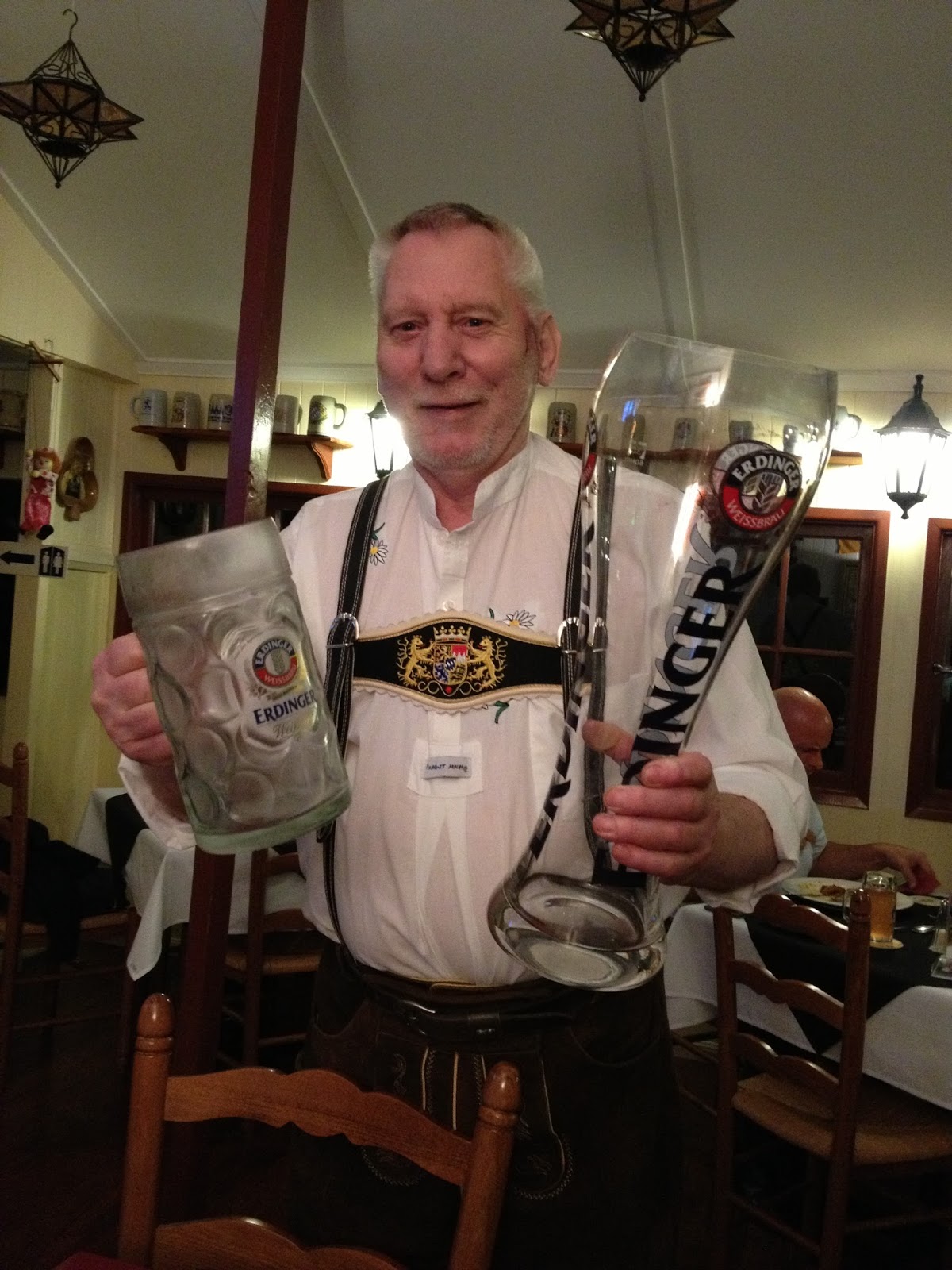
Wearing Lederhosen, our host simultaneously welcomed and handed us the beer menu. The interior of Black Forest is quintessentially German. The timber chairs, cuckoo clocks, Beer Steins (ceramic German beer mugs) displayed on high shelves, German flags.....and the music. We could have been  sitting in Leutkirch im Allgau........or somewhere. 

 While waiting for Keith and our friends Jo and David to arrive, the boys and I each ordered a different  beer (Boetie's non-alcoholic, of course, and actually not that bad!), each arriving in an appropriately shaped glass to complement the style of beer. This was accompanied by a platter of cold meats and pickles (kleine Wurstplatte). Given the fertile farmlands and consequent high yields, storing excess produce by pickling vegetables and smoking meat became an integral part of German cuisine. Everyone knows Sauerkraut (shredded cabbage preserved through the natural process of lacto-fermentation) and German Speck (smoked pork belly), widely used to flavour stews and soups.

Having been to Germany, the food was predictable and did not disappoint. So here we go: Mahlzeit! 

Nielen made sure he was the first to order the Jagerschnitzel with homemade noodles; Boetie opted for the Wildschwein Pfeffer  (wild boar ragout) which he devoured; Jo, who I am happy to announce had her first beer EVER, gave the thumbs up to her Bayrischer Zwiebelrostbraten, complete with a secret Gruenwald sauce, green beans and potatoes; David expressed surprise on how much he enjoyed his Schweinefillet in Rahm (pork fillets in a rich, creamy mushroom sauce); I had the Tiroler Schweinbraten with sauerkraut and dumplings.  Keith, ordering last, settled for the Bayrischer Bauernschaums, essentially a huge plate featuring a handfull of the 1000 different sausages available in Germany, served with sauerkraut and mashed potatoes. The food was freshly prepared, extremely tasty, quite rich and very filling. The portions were huge. So much so, that we all skipped dessert. We simply could not face the puddings and crepes and tortes...not even the Black Forest Cake.

We had a most enjoyable evening, made even more so by the sharing of fun facts about Germany. Jo shared her professional wisdom on German prosthetics, I bored everyone with useless statistics, Keith again presented his facts with visual support, Nielen pointed out that the tallest cathedral in the world is situated in Ulm, Boetie dissected the German flag....and we honestly could have done without David's vivid description of exploding toads and attacking crows!

Time for a change of pace: next week we travel from punctual Germany,  to laidback Jamaica, mon!

Our host at Black Forest Restaurant

Bayrischer Zwiebelrostbraten

Schweinefillet in Rahm

Tiroler Schweinbraten

Friday, 30 August 2013

Week 6: Croatia

30 August 2013.
Week 6: 101 Croatians

What do Marco Polo, John Malkovich, Mario Andretti, Eric Bana and the Dalmation dog all have in common? If you connect all the dots, you'll soon discover that they are all Croatian. So are Misho and Tania, who own Restaurant Misho's in the suburb Taringa, 5km southwest from Brisbane's city centre. The suburb is dominated by  a long ridge with steep slopes to either side. The aboriginal word Taringa literally means "place of stones". It is mainly residential, and a popular neighbourhood for students, as it is cycling distance to Queensland University.

Today, about 51 000 Croatians call Australia home. There were essentially 4 waves of migration to Australia: during the 1851 gold rush; resettlement of displaced people after WWII;  during the anti- Croatian sentiment in Yugoslavia in the 1960's/70's, and more recently during the government's "Family Re-union" program. Sense of family is key to the Croatian fabric, which was evident at Misho's, with most tables occupied by large family groups, representing all generations.

I knew very little about Croatia, and even less about their cuisine until last night. Misho and Tania, who have lived in Australia for nearly 50 years, come from the breathtakingly beautiful Dalmatian Coastline on the east coast of Croatia. Tania explained, that there the cuisine is dominated by the abundance of seafood and the Mediterranean influence. There is huge respect for the integrity of the fresh produce, and very little is done to alter its natural flavours.  Most seafood is grilled whole, with minimalist interference (maybe a bit of butter, garlic and parsley).

So, Dobar Tek!

Charcuterie is part of Croatian tradition, and we duly started with a platter of grilled skinless pork sausages washed down with the obligatory Croatian beer. Then I had the signature grilled fish dish, which must rate as one of the best pieces of fish I  have had in a very long time. Our friends Hubie and Lani  shared the Monarski Pijat,  or grilled seafood platter, and Keith ordered the Brudet, the Croatian version of the French Bouillabaise or the Italian Brodetto. It is an impressive fish stew with a delicate fish stock at it's core, around which the layers of flavour are built. The tomato is extremely subtle, and together with the reduced white wine, it adds a fragile acidity that glues the ingredients together. This is usually served with soft polenta.  If this is how they eat in Dalmatia, no wonder the average life expectancy is 75!

But Dalmatia is only one of many regions in Croatia. The mainland food is characterised by contact with its neighbours (Hungary, Austria, Slovenia), and the cuisine is often described as the "cuisine of regions", as it is so varied. Former Yugoslav recipes also feature prominently. Boetie and Nielen both had the Beef Pasticada  (beef larded with bacon, poached in red wine vinegar and port, served with fried gnocchi). And yes, I know they broke rule #3 ( see week1), but sometimes one has to be forgiving.

For dessert the most popular choice was the Rozata (Croatian version of the crème caramel), and I devoured the Palacinke ( crepes with sweet macerated strawberry filling).

If we lived in medieval times, we would have had to trade a couple of kuna (martens) pelts to pay for our meal. As Boetie informed us, the kuna is the national animal ( family of the mink...hence the value of the pelts). Today, it is also the name of the Croatian currency. One Aussie Dollar (at today's exchange rate) converts to 5.1 Kuna, and the agile furry little animal still features on the coins and notes. Fortunately, no blood was spilled, as the modern convenience of the credit card did the job.

We learnt multiple interesting facts about Croatia last night, too many to mention. However, did you know that the necktie is an Croatian invention? It originated in the region Kravata, where wives and girlfriends would tie a narrow scarf around their partner's neck before they went off to war, to remind him of her love. Today over 600 million neckties are worn daily all across the world.

Now we can tick Croatia, and trade our neckties for lederhosen. Yes, next week wir fahren nach Deutschland!

 Croatian crème caramel

Signature grilled fish

Misho's Mornarski Pijat

 Brudet Marko Polo

Friday, 23 August 2013

Week 5: Peru

23 August 2013

If you believe size matters, then Peru is the place for you: it boasts the world's biggest sand dune, deepest canyon, highest navigable lake and longest left hand surf break. Our mission, however, was to size up it's culinary dimensions.

Peruvian Cuisine is shaped by its geography. The coast, the mountains and the jungle. It includes many pre-Inca and Inca staples, and is heavily influenced by the many immigrants (mainly the Spaniards and their African slaves (Moors),  later the Chinese, French and British). We visited "Red and White" in the suburb South Brisbane.  There are only two  restaurants with authentic Peruvian cuisine in Brisbane, and I believe "Red and White" offers a more refined interpretation. Replicating the colours of the flag, the restaurant interior is painted in red and white, with graphics of the mysterious ancient Nazca lines on the walls. The atmosphere is welcoming, with traditional music playing and the flag draped across the desk at the entrance. Now for the food....


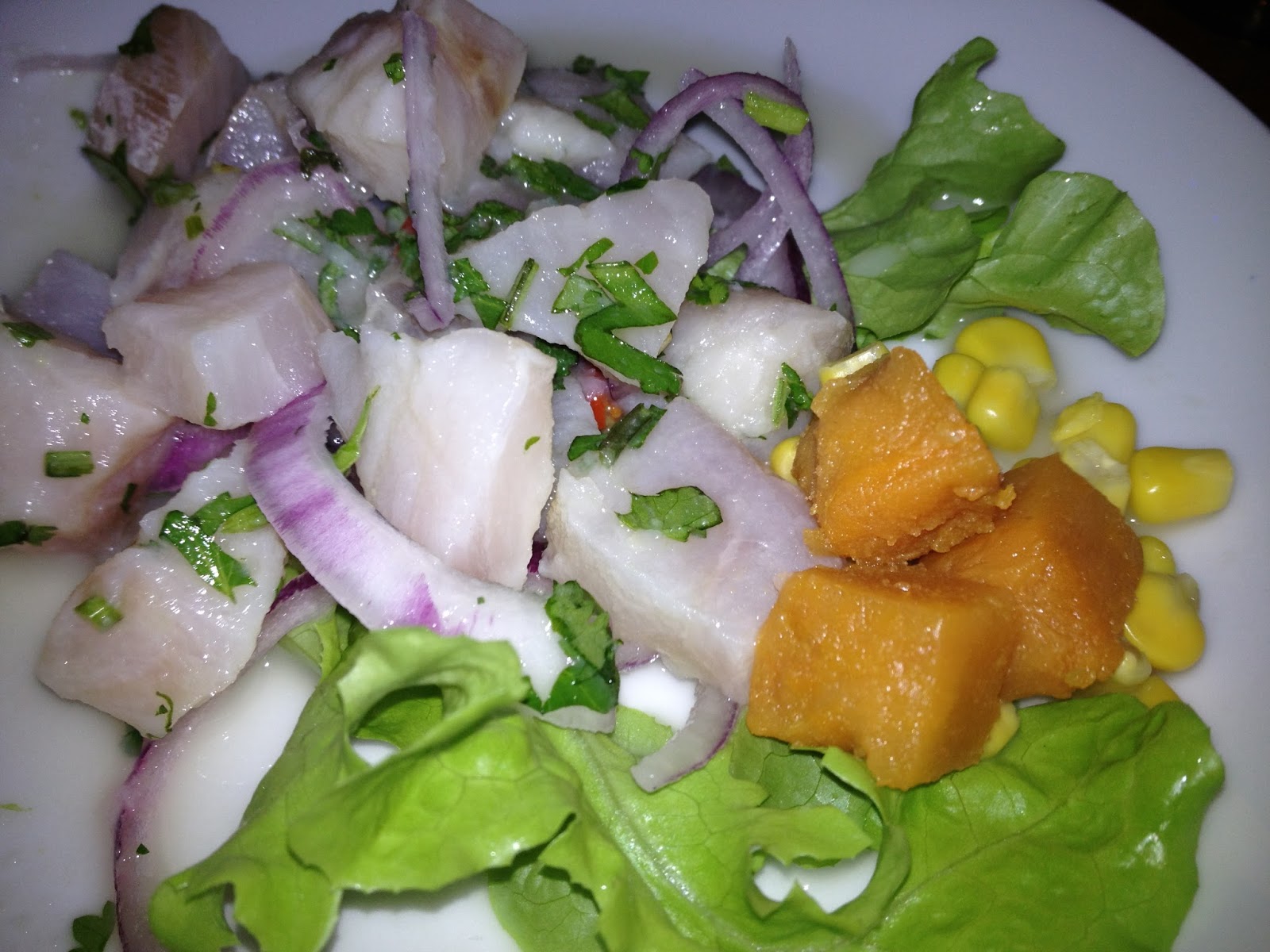
To start, I ordered the Ceviche, Peru's national dish: Boneless, skinless, diced raw fish, uniquely cured in lime juice, spices and fresh coriander. It was delicious. Nielen and Boetie shared the chicken Empanada  (Peruvian style pastry), Keith had the Causa Limena (mashed potato with Peruvian yellow chilli, boiled egg and olives). Martina joined us again.....pattern of interloping developing here!.....and had the Pulpo al Olivo (octopus salad), and newcomer Phil skulled the  Leche de Tigre Shot : an aphrodisiac hangover cure of mixed fish and lime juice with aji (yellow chilli) and other magical spices.

For the mains, true to the rules (see week 1) we all ordered something different:  creamy shredded chicken with potatoes (Aji de Gallina),  Peruvian style Paella, beef stirfry (Lomo Saltado), lamb stew (Seco de Cordero), pork casserole (Adobo de Chancho) and a fish stew (Sudado de Pescado).  The spice profile of the food is delicate and subtle, but I am sure one could easily amp it up with a bit more aji.   We shared a bottle of Argentinian red wine, and of course, there were a couple of  imported Peruvian beers.....Nielen now collecting a bottle from each country.

We shared three desserts: Pan Chino Frito essentially a doughnut, Leche asada  Peruvian baked custard, and an incredibly sweet Suspiro a la Limena  with raspberries.


The number of diners in the restaurant from that specific country, is always a good gauge of cultural authenticity. And they were there - not lingering - dining and leaving. About 1000 Peruvians live in Brisbane (roughly 10 000 in Australia). With the immigration laws tightening, most Peruvian migrants today are young people on student visas. And with them they bring  their cultural riches, positive disposition and willingness to integrate. This was underlined by the friendly and efficient service of our young waitress, who has only been in Australia for 3 weeks, studying at one of the local universities.

The evening would not be complete without  the trivia (another rule...see week 1). Keith entertained us with a visual presentation of the pink fresh water dolphins of Peru; Boetie did not disappoint with yet again sharing the national fauna facts; Nielen, true to form, awakened our conscience by stating the poverty and unemployment figures; Martina focused on historical and educational issues, and my introductory paragraph is courtesy of Phil!

Week six will take us to Croatia. Until then, Buen  Provecho!


Empanada

Ceviche

Seco de Cordero

Arroz con Mariscos

Causa Limena