Friday, 25 July 2014

Week 46: Denmark

Week 46: There's nothing rotten in the state of Denmark.


In fact, things couldn't be better. The Kingdom of Denmark is considered to be the worlds most democratic and least corrupt country, it has the world's highest income equality, level of well-being and life expectancy, and the Danes are consistently ranked as the world's happiest people. And of course, it has the world's best restaurant. Noma, a portmanteau of Nodisk (Nordic) and Mad (food in Danish), has been awarded this prestigious title in 2010, 2011, 2012 and 2014 (not quite sure what happened in 2013...).
Situated in a stripped-back warehouse on the Copenhagen Dockside, Noma serves "mould-breaking Nordic food that takes natures bounty to a new level....food that makes you glad to be alive" (judge's comment, 50 Best Restaurants in the World). The cuisine is intrinsically linked to the Nordic terroir, and a re-invention and interpretation of the everyday food that the Danes love to eat.


Mealtime is very important to Danish families, as it contributes to their sense of well-being (hygge). They would typically have 3 meals a day: a cold breakfast of rye bread, cheese and jam/ a cold lunch (smorrebrod) consisting of rye bread, cold meats or smoked salmon,  liver paste, cucumber and tomato, hard boiled egg and curried pickles/ and a hot dinner which may include frikadeller (meat balls), sausages, roast pork or poached cod. Denmark has a reputation of excellence when it comes to butter and cheese (think Havarti and Danish Blue). They excel in the fine art of pastry-making (what we refer to as Danish pastries, they call Wienerbrod). And they love pork (Danes eat the most pork per capita in the world).


Last night we had dinner at The Danish Club, situated on Austin Street in Newstead (3km north of the CBD). The suburb's trendy cafes and upmarket studio apartments belie its industrial past. Conveniently located on the northern bank of the Brisbane River, it once was home to timber yards, asbestos factories and wool stores, as well as Brisbane's gasworks. Today Newstead is one of the more expensive areas to purchase property in Brisbane.


There are 62,014 Danes who call Australia home, and according to Soren (Club President), about 5000 live in Brisbane. I would estimate there were about 90 enjoying the traditional Smorrebrod  at the club last night. On arrival, we made ourselves comfortable at our reserved table with a couple of Carlsberg and Tuborg beers. Fact-sharing flowed freely (see blog week 1 regarding Friday Night Out Rules). It wasn't long before a queue formed at the food counter, snaking all the way to the back of the hall. Not wanting to miss out on whatever was on offer, we fell in line. What we discovered, was the renaissance of the open sandwich. Dark rye bread with a variety of mouth watering toppings:
smoked salmon with thinly sliced red onion and capers; crumbed and fried fish fillets with remoulade and lemon; roast pork with crackling, red cabbage and a slice of orange; rare roast beef with remoulade and onions; rolled and spiced pork belly; liver paste; crispy bacon, boiled egg, Danish salami, Esrom (stinky cheese) and more. The food was delicious, the beer was cold, and one could even do some shopping - does it get any better? The Danish butcher was selling a selection of premium meat products and smallgoods, Britt's Organic Bakery was there with a variety of pastries, bread and biscuits, and one could also buy imported Danish liquorice. A festive atmosphere was created by the lucky draw (9 prizes in total, with Phil and Martina both walking away as winners!), and Greg at one stage offering that he was having a ridiculous amount of fun.


So what did we learn from each other about Denmark? Martina informed us that there is no word for please in Danish;  Keith had numerous facts about Lego (there is a lot to say about these little building blocks  - a company worth $15 billion).We also talked bout Jorn Utzon, the architect of the iconic and Heritage Listed Sydney Opera House with its geometrically undefined curves (and how he never saw the finished building). There were facts about Hans Christian Andersen and The Ugly Duckling and the national animal, the Mute Swan. And how could we not mention our very own fairy tale: Australian born Mary MacDonald met Crown Prince Frederik in a pub during the Sydney Olympics in 2000 (can you image that introduction.....), and turned into a beautiful princess. Greg praised the virtues of Danish nannies; and Phil threw me a red herring: he told us that the famous 1967 hit Zabadak by Dave Dee, Dozy, Beaky, Mick and Tich mentioned the Skagerrak Strait in its lyrics. So here I am this morning, looking at Youtube footage of this song, only to discover that the words are gibberish, and they actually say skagalak ( to rhyme with zabadak, I assume) -  and surely the last thing on Dave Dee's mind when writing the song was the body of water between Denmark and Sweden.....


So where do we go from here....ever been to Laos?


Friday, 18 July 2014

Week 45: Colombia

Week 45: Colombia - the lungs of our planet


We may well have stumbled across the world's best kept secret. When it comes to diversity of landscape and wildlife, look no further. From snow-capped volcanoes, rocky deserts, endless plains, alpine lakes and dense jungle to two toed sloths, hummingbirds, capybaras, jaguars and harlequin frogs...Colombia is considered to be the most prolific biosphere on earth. Having suffered a terrible reputation of crime and violence, Colombia has cleaned up its act, and is very proud of the huge progress they have made in stabilising their country socially, economically and politically.


If you need further testament to the wealth of wildlife, then look up. Colombia has the largest bird list in the world, with 1872 species of avifauna filling their sky. And if bird-watching is not your thing, intellectual Bogota ( the capital) will oblige: cutting-edge art, experimental theatre, vibrant Latin music scene  and of course food. Colombian cuisine is a blend of European and native ingredients. It is extremely diverse, and most people would not know what the traditional food of Colombia encompasses. It varies greatly from northeast to southwest, but one thing is for certain - they love meat, and lots of it. Many consider Bandeja Paisa to be the national dish - a platter filled with steak, pork crackling and chorizo sausages, accompanied by beans, rice, avocado and sweet banana chips, topped off with a fried egg....not for the faint-hearted. Another speciality is Lechona - a whole pig, stuffed with rice, peas, onions and spices, then roasted in a clay oven for 10 hours. And if you prefer to indulge in a local phenomenon, try the Hormigas Culonas (queen ants - wings and legs removed, soaked in salt water, then roasted - literally translated: big ass-ants). Arepa is a cornmeal bread served with every main meal, and for snacking, you can't go past a delicious, stuffed and fried (as opposed to baked in most other South-American countries ) Empanada.


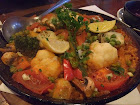
To experience the taste of Colombia, we travelled to Woolloongabba,  2km south of the CBD (see suburb history and profile week 9: France) to Evo Colombian Restaurant. Brothers Sam, Luis and Carlos fulfilled a lifelong dream when they opened Evo. Mum Teresa lends a helping hand in the kitchen, bringing the traditional flavours of her homeland to every dish. Que aproveche! Last night was terribly windy and very cold, so the blankets draped over the back of each chair came in very handy (albeit that we sat inside). Friday night is Tapas night. Showcasing the strong Spanish connection with a Colombian touch, the seven of us ordered a selection of share-plates: Empanadas (stuffed with potato and herbs), chorizo sausages in red wine, garlic infused mushrooms, salty fried king prawns, baby octopus, and a vegetarian paella. This went down well with some Colombian beer and a couple of glasses of red wine. For a more authentic experience, rather visit Evo on a Sunday, when they serve a full Colombian feast. There are just over 21,000 Colombians living in Australia - the largest group of immigrants from South America- most settling here during the troubled times experienced in Colombia in the 1980's. Unlike other countries in the region, the Colombians who move to Australia are mostly urban and educated (part of the significant brain-drain of the country). Many of them choose Brisbane, and this Sunday (20 July) will see the first Colombian Independence Day Festival in Fortitude Valley when food, drink, music, salsa and cumbia will bring Carnival to town.


No Friday Night Out is complete without the sharing of facts - and there were many. The biodiversity was discussed at length. Colombia (named after its founder, Christopher Columbus) has over 162 species of Hummingbirds ( the only bird that can fly backwards), the Andean Condor is the national animal, and the capybara is a barrel-shaped, giant, semi-aquatic rodent that lives on the river banks. We discussed the building and cost of the Panama Canal, and the proposed Colombia-China joint venture to build a rail alternative to boost trade. We touched on the legendary lost city of gold, El Dorado, and briefly mentioned the coffee trade. A positive story, is that Colombia is no longer the world's largest producer of cocaine. This title now belongs to Peru. And Jane concluded with a few Colombian rules of social engagement : eye contact, handshakes and family history - all very important preambles to a meaningful meeting ( probably to determine on which side of the thin white line your allegiance lies, we decided....).
And how can we conclude Colombia without mentioning the most significant revelation of the World Cup Football: James (pronounce HAHM-ez) Rodrigues - the new pin-up boy of soccer.  With a kiss on both cheeks from our delightful young waiter Rodolfo, we departed filled with Latin-American cheer.

We say farewell to Andrew and Jane, who return to South Australia after joining us on four of our culinary expeditions. Adios!
And we welcome the prospect of travelling to our first (and only) Scandinavian destination - next week we'll see  you in Denmark !


 James Rodriquez
capybara

Friday, 11 July 2014

Week 44: Cuba

Week 44: Che, Castro, coffee and cigars.


These topics dominated discussion on Friday morning. Yes, slight tweaking of the FNO rules (see blog week 1). As our Cuban destination only opens its door weekdays from 7am until 2pm,  we had no choice.


But first, allow me to tell you more about Cuban cuisine. More mild than wild, traditional Cuban dishes rely on muted spices and extended simmering to build flavour. Hot chilies are eschewed for milder spices like cumin, cinnamon, bay leaf and oreganum.  Beef and pork are the preferred meats, and being an island nation it is obvious why seafood features prominently.  Christopher Columbus arrived on Cuban shores in 1492. He brought with him the flavours of Seville - oranges and lemons, as well as rice and vegetables. With perfect conditions to cultivate sugarcane, African slaves were imported to work the plantations. The fusion of Spanish and African cultures form the backbone of Cuban cuisine, with Black Bean and Rice Stews, known as Moros y Cristianos ( Moors and Christians) typifying the unification. Crucial to just about every dish is the addition of olive oil, sour orange juice, onions, cumin and paprika - a sauce called mojo. And without the mojo, a dish would lack the necessary balance in flavour that gives the food its charm.


However, I cannot expand on whether Cuban cuisine has lost its mojo, as our breakfast destination focussed on the sweet essence of Cuban coffee and cigars (without doubt the two most important food groups in Cuba....). Paladar Espresso Bar and Fumior Salon on Merrivale Street in South Brisbane brings a little bit of Cuba to the heart of Brisbane. From it's welcoming revolutionary red exterior to the collection of eclectic curios inside, it is an espresso bar like no other. The flavours and sounds of Havana fill the tiny shop, with purveyor Filip (always ready for a chat) barely visible behind the counter stacked with memorabilia, cookie jars and the espresso machine. To the back of Paladar is a cosy courtyard, should you wish to have your coffee there. If you take the stairs to the sunny rooftop terrace, you may complement your cafe cubano with the peppery, leathery, toasty, woody, chestnutty or earthy flavours of an imported Habana cigar.


Prior to the Castro-era, coffee production flourished, and Cuban coffee accounted for a huge percentage of the country's export revenue. Economic disaster struck in 1959 (when coffee production was at its peak) as the Marxist revolution swept Castro into power and started to confiscate farms and nationalise all industries. Today coffee accounts for only 1 % of all Cuban exports.


On the other hand, Cuban cigars are one of the country's top exports. It dominates the world cigar market with 70% of the sales. This jealously guarded market share excludes the United States, where Cuba's cigars are banned under a decades-old trade embargo against the Communist Island.


The dexterous fingers of Cuba's cigar makers rolled out 81.5 million of the much sought-after smokes last year, with demand being driven by the Chinese market.  We selected two cigars from Filip's extensive collection and were issued with a cutter to cut the head and butane torch to ignite the foot - one slightly sweet, and the second quite nutty. When in Cuba.....


With the strong, dark, concentrated coffee-bean extract acting as the octane to fuel our day, the sharing of facts began pretty much from the get-go: Che Guevara, Fidel Castro, The Bay of Pigs, The Cuban Missile Crisis, Guantanamo Bay  -  politics again predominating discussion. Myths were expelled (no, Cuban cigars are not rolled on a virgin's thigh) and hoodoo explained (a folk spirituality with the belief that human well-being is governed by spiritual balance, and the use of charms to embody spiritual power....not to be confused with voodoo from Haiti). And somehow it was even possible to include some celebrity gossip: Beyoncé and Jay-Z caused a media frenzy with their recent trip to Cuba despite the US-Cuban travel and trade embargo (imposed by JKF 52 years ago, and re-affirmed by the Obama administration in May 2014). Obama had the chance to take a slick jab at Jay-Z at the annual White House Correspondent's Dinner.  Talking about issues that he has to deal with that are out of his control, Obama said, "It's unbelievable... I have 99 problems and now Jay-Z is one of them." Interestingly enough, the President does not appear to be as concerned about Beyoncé.....


This Friday was definitely more of a cultural than a culinary experience, one all eight of us wholeheartedly embraced. Next Friday all will revert to normal, as we investigate the tastes of Colombia.
  Filip the owner of Paladar
  Louise looking quite accomplished

Saturday, 5 July 2014

Week 43: Iran

Week 43: The cradle of civilisation.


I am puzzled (as Andrew would say). Why is there so much conflict, violence and intolerance in this region that is the cradle of our civilisation? It is for this very reason that Farideh (Fay) and her family sought refuge in Australia 33 years ago. Today there are just over 70,000 Iranians living in Australia.  Fay met her American husband of 29 years (an award winning composer/concert jazz guitarist) in Cairns , and it is he who encouraged her to share her incredible flair with her native cuisine with the dining public of Brisbane. Zafron on Brunswick opened in 2007 and has established a reputation for quality, providing guests with a variety of Persian dishes  - both traditional and some with a modern euro twist.


Although often lumped in the category Middle Eastern Cuisine, Iranian food stands apart when it comes to the unique ability to contrast flavours. They are particularly adept at balancing sweet and sour, using pomegranate syrup, dried limes and quinces to achieve the desired result. The Iranian meal is built around rice (bernej) - often a plate stacked with chelo (plain cooked rice) or polo (rice cooked with several ingredients)  topped with vegetables, fish or meat. Herbs and spices like saffron, cinnamon and parsley add a refined definition to the flavours of Iran. Nuts, raisins, plums, apricots and yoghurt add texture, sweetness and balance to the often spicy toppings. There are over 40 different types of bread in Iran, from crisp to limp, and at least one type of bread will accompany every meal. Befarma'id!


Six of us had dinner (shaam) at Zafron in New Farm on Friday night. We started with two platters to share. The Persian Dip Platter: three dips( eggplant, garlic and tomato/  spinach yoghurt and pine nuts/  olives, walnuts and feta) served with fried lavash crisps and hot Turkish bread; and the Mediterranean Dip Platter (artichoke, fig, crushed almonds/ roasted capsicum, macadamia, yoghurt / and tahini with roasted garlic). These dips were all interesting, different and delicious. True to Friday-Night-Out Rules, we all had a different main: Andrew ordered the Fesenjan (stewed chicken pieces, slow-cooked with walnuts and pomegranate molasses, served with saffron rice and yoghurt); Jane really enjoyed her vegetarian tagine with a Moroccan touch; Keith had the
Khoresht–i-Shirazi ( Fay's own stew of authentic Persian Spices, potato, eggplant and carrots with yoghurt and crushed pistachios and cashews, served with Saffron Rice ); Boetie had the Chelo Kebab (traditional kebabs char-grilled over the in-house BBQ served with saffron rice, yoghurt and Shirazi salad); Nielen opted for the Khoresht-i-gormeh Sabzi (Persian stew of slow-cooked lamb, Borlotti beans, dried limes and blended herbs served with saffron rice and Mostakhiar yoghurt) and I absolutely loved my Polo ( a rice pilaf with almonds, raisins and bite-size meatballs served with Mostakhiar yoghurt). Jane and I concluded our meal with some Persian tea. All this while listening to soothing jazz guitar recorded by Fay's husband, Michael, playing as background music in the restaurant.  I have to agree that the food is fundamentally different to the other Levantine cuisines that we have tasted. It definitely had an element of refinement which elevated the meal from its apparent basic ingredients into one of sophistication. A cuisine worthy of further investigation.

Jane had first go with facts on Friday ( seeing that she never had her say in Sri Lanka....) and came prepared with 65 of them! One of which is that the official name of Iran is the Islamic Republic of Iran. It became an Islamic republic in 1979 when the monarchy was overthrown and religious clerics assumed political power under the supreme leader Ayatollah Khomeini. Andrew explained the qanat water supply system; Nielen turned our attention to the horrific air pollution in Teheran, and stated that on average 27 people die each day due to related causes. Keith expanded on another fact by Andrew, that all Persian rugs are purposely made with a defect. We talked quite a bit about Persian rugs, Iranian caviar and the Caspian Sea. Did you know that the Caspian Sea is situated at 28m below sea level (-28m), it is completely land locked, is endorheic (has no outflow), and is fed by over 130 rivers? And lastly Boetie analysed the flag:  Known as the ‘Three Colour Flag’ ( green/white/red), the flag of Iran was officially adopted on July 29, 1980.  To the bottom of the green band and top of the red band the takbir is written twenty-two times in the Kufic script. The takbir reads the phrase Allahu Akbar which translates into “God is greater than can be described.” The number twenty-two is significant as it refers to the Islamic Revolution that occurred on the twenty-second day of the eleventh month of the Iranian calendar. 

It is always best to steer clear of discussing politics and religion over dinner, but with Iran it is impossible. Hopefully we'll be able to sidestep these topics in Cuba next week. With a coffee, cognac and cigar in hand, I somehow doubt it. Castro and cults may well be on the menu.........


Friday, 27 June 2014

Week 42: Sri Lanka

Week 42: The Teardrop of India....
or Pearl of the Indian Ocean, or Resplendid Island...call it what you want, Sri Lanka offers a cuisine that is exotic, fragrant, delicious and spicy. Lighter than Indian cuisine and including Thai components (like coconut milk a plenty), the food explodes with flavour.


If Curry and Rice is your Friday night favourite, travel no further than La Kandy on Wynnum Rd in Tingalpa ( meaning place of the waterpepper plant in aboriginal language).  Chaminda and his dad own this cosy restaurant, located 10km east of the CBD. The restaurant is named after the beautiful and culturally rich city of Kandy, the last capital of the ancient kings of Sri Lanka. On weekends they offer an extensive traditional buffet showcasing the beguiling flavours of this island nation.


On arrival, we were treated to a basket full of freshly made hoppers - a feather-light bowl shaped pancake made from fermented rice flour. Some had a fried egg inside - typically served at breakfast.
For mains, the buffet awaits: you can compare the delicate fish curry to the spicy beef curry, or the aromatic pumpkin curry to the mild dhal curry, or simply indulge in the chicken (I-want-more) curry. For me the interest of this cuisine lies in the abundance of sambols (side-dishes or sambals in Indian cuisine). I find it fascinating how these cleverly designed  sides can actually manipulate the taste-profile of the meal. For example - add some dried fish slivers to adjust the saltiness of the curry; add pol sambola (sweet coconut balanced with sour limes and hot chili) to add texture and heat, or some achcharu (vegetable pickle) which adds a bright flavour to the meat. Then of course there is the cooling and soothing raita (yoghurt, garlic and cucumber) to counter the spicy high notes. The Sri Lankans have mastered the art of spice combination. Martina's fact (see facts-sharing week 1 blog) is worth mentioning now: Sri Lanka is responsible for 91% of the entire world's cinnamon supply. Cinnamon (native to Sri Lanka) is a key ingredient in a variety of dishes all over the globe - from sweet American apple pie and sugar-dusted Dutch poffertjies to fragrant Moroccan tagines and fiery Sub-Continental curries. Other spices in their arsenal include chili, nutmeg and mace, betel, black pepper, ginger, cloves, cardamom, lemongrass, vanilla bean and cocoa. To conclude our meal we were offered traditional Sri Lankan sago pudding or their take on a baked caramel. Both rewardingly sweet and infused with subtle nuances of cardamom and cinnamon.


The eight of us all agreed that the food was delicious - the perfect Friday Night Out curry and rice, lovingly prepared and proudly presented by Chaminda and his staff. But what is Friday night without the facts, Keith asked, keen to share his knowledge on The Temple of the Tooth (built specifically to house the remains of one of Buddha's teeth after his cremation...long and fascinating history as to how it ended up in Sri Lanka). Boetie informed us that the national animal is the lion (a symbol of power and strength, also depicted on the flag), Anna shared the fact that Sri Lanka has the most deaths-by-snakebite in the world, and Martina expanded on the amazing properties of cinnamon (also an effective insect repellent). Andrew, joining us for the first time, stated that when he visited Sri Lanka, it was still known as Ceylon (which is a fact in itself), and gave us a brief synopsis on recent occupations: Portuguese colonisation in 1505 / Dutch usurped control in 1658 to 1796 when the British took over and ruled Ceylon right up 1948, when it gained independence / 1972 it became a republic named Sri Lanka. Phil mentioned that famous British science fiction writer A.C. Clarke (perhaps most famous for being co-writer of the screenplay for the movie 2001: A Space Odyssey) moved to Sri Lanka in 1956, aged 40, to pursue his love of scuba diving, and died there in 2008. Then we became so embroiled in a discussion on the political complexity of the place, that we completely neglected to ask Jane to share her facts (next week you'll go first, Jane!). There are 86,412 residents in Australia that were born in Sri Lanka and 103,772 by ancestry ( making them the 12th largest ethnic group in the country).


Having visited India, Pakistan, Bangladesh and Sri Lanka, we have now well and truly explored the curry capitals of the world. Which one was my favourite?...you'll have to wait and see.


Next week (despite the government's travel warning) we visit one of the world's oldest civilisations: Iran (Persia).


Friday, 20 June 2014

Week 41: The Czech Republic

Week 41: The Bohemian world of jingling keys and defenestration.
We were supposed to visit Scotland this week, but low and behold...Scotland doesn't exist anymore! The only Scottish restaurant within our parameters (see rules week 1) closed its doors. Quick change of itinerary, and off to The Czech Republic we went.


This landlocked sovereign nation has the most amazing history. The capital city Prague was once the capital of the Holy Roman Empire (962 AD), then The Kingdom of Bohemia (1212), the Austro-Hungarian Empire (1867) and the former Czechoslovakia (1918). After 41 years of communist rule, the bloodless "Velvet Revolution" of 1989 led to the formation of a democratic government. One element of demonstration in support of the Velvet Revolution was the jingling of keys. Protesters would jingle the keys in their pockets, a telling sign to the communists: "Goodbye, it's time to go!". It also symbolised the unlocking of doors and opening the country to new opportunities. The only threat to peace was the ethnic conflict between the Czechs and the Slovaks, which resulted in the "Velvet Divorce" - an amicable split to establish two sovereign states (1993): The Czech Republic and neighbouring Slovakia.   


In search of authentic Czech cuisine, we travelled all the way to The Czechoslovakian Club  in Burbank, a 15 minute drive southeast from Brisbane city. Burbank is a large greenbelt suburb, and a declared Koala Habitation Protection Area. Named after Alfred Burbank, a well-known horse dealer who settled in the area in 1890, the suburb is dominated by large acreage properties with extensive gardens and prestige housing (it has the third highest median house price in Australia). Fifty years ago, refugees from the communist ruled Czechoslovakia founded the club on a huge property in rural Burbank....now they are sitting on real estate gold!


It was the first time we needed our headlights on beam to find our destination. Burbank does not have any streetlights, there are no shops nor public transport. We took a right turn off Mount Cotton Road onto a compact gravel track winding through thick vegetation. As we passed through the Club's gated entrance, we were surprised to find a large building with out-buildings and a packed carpark. We approached the veranda with a light sense of excitement, like true intrepid travellers embarking on an adventure with unknown consequence.


We opened one of the French doors with red check (czech.....sorry!) curtains concealing the view to the inside. Immediately to our left was the most important part of the club: the bar. We signed the visitors book, noticed my name on a reserved table card  - Mariki (well, I assumed it was me...) - took our place and absorbed our surroundings: the huge rectangular hall had a friendly and intimate atmosphere; most of the tables were occupied by big family groups, old friends, young couples; longstanding members greeting each other by first name, and kindly nodding our way to acknowledge our presence.....confused as to who we were; flags, crests and paintings decorate the walls; big televisions screen footage of their homeland - images so beautiful, we immediately added a visit to Prague on our bucket list.


But first things first. While waiting for Phil and Martina to arrive we bought two Czech beers at the bar: Keith had a Zlaty Bazant, and I had a Pilsner Urqell, brewed in Plzen, the home of Pilsner Beer. Mine beautifully bitter, Keith's smooth and quite sweet.  We were encouraged by Stanya (club secretary) to place our orders, as they quickly run out of the more popular dishes. She explained how it works: There is a set menu. You order and pay at the bar. For $16 you get a bowl of soup with bread, a choice of 4 mains, a dessert and tea or coffee.  You receive a number and your dessert on a big red tray. Then you progress to Eva who will dish up your steaming hot home made soup, you take some bread, grab your cutlery and off you go. When your main meal is ready, your number is called over the PA system and you collect your plate from the serving counter. When you are done, you return your tray to the kitchen. I jokingly asked if I should also wash my own plate, upon which Stanya cheekily answered: "Don't ask twice!"


Last night's menu featured Barley soup. It was delicious: a flavour-packed broth, dense with barley, potatoes and vegetable greens. For the mains, one could choose either Scegedin Gulas with Knedlik (Goulash with dumplings),  Plnene Bramborove Knedliky zeli smaz Cibulka (Stuffed Potato dumplings with home made sauerkraut) or Veprovy (pork) or Kureci (chicken) schnitzel with Bramborovy Salat (potato salad). The four of us decided to order a different main each, eat a quarter, and then pass our plate clockwise, so we could all taste the Czech spread in front of us. The goulash was amazing - the meat so tender, it simply melted in your mouth. The dumplings were bread-like, the ideal vehicle for mopping up the rich gravy infused with onion and herbs. The potato dumpling was stuffed with minced, cured pork and served with sauerkraut. The sauerkraut deserves a special mention. Clearly not from a brine-filled jar, or an imported tin, this sauerkraut was so fresh, one could actually smell the lacto-fermentation process converting the sugar in the cabbage to the tantalizing sour taste loved by so many. And the schnitzels were perfectly cooked: golden crispy crust encasing the meat - tender and juicy inside. This was served with potato salad and some greens. The dessert was a baked cherry cake (careful...stones included!), light and fluffy.


We really enjoyed our evening, and it was hard to believe that we were in Brisbane and not Brno. There are 31,079 Czech descendants living in Australia, most moving here after WWII. A  recent spate of young Czechs are electing to study at Australian Universities. That is surprising, as The Czech Republic has some of the most advanced universities in the world. They recently opened  CEITEC, a modern science research centre, leading the world in genomics, nanotechnology and biology.  At CEITEC they developed a self-cleansing paint for buildings, a gel to fix broken human bones and plastic packaging made form deep frying oil waste, that spontaneously disintegrates after a few months.....the list goes on. Other interesting facts shared last night included their love of beer ( highest world consumption - 160l per person per year), manufacturing (from Skoda cars and hockey pucks to radar and soft contact lenses) and Defenestration....allow me to expand:
Defenestration  is the act of throwing someone out of a window. Prague is the world capital of defenestration, with two very significant "defenestrations" shaping its history. The first one occurred in 1419, when a crowd of radical Czech Hussites expressed their discontent with the direction of the Catholic Church by throwing 14 council members through the window - 7 died. The second important defenestration (1618) was the fate of four Catholic Lords Regent at the hands of disgruntled Protestant Lords (long story... worth reading) and triggered a 30 year war!


We live in a fascinating world. Dobrou chut!


More winter food next week...some fragrant curries from Sri Lanka, perhaps?


Friday, 13 June 2014

Week 40: Switzerland

Week 40: Francs, Fondue and Federer.


I saved a couple of countries specifically for the winter months, and was getting quite worried. It is mid June, and we are still wearing shorts and sandals. We are experiencing unseasonably hot weather, but fortunately yesterday was the first day this year that remotely resembled winter: cloudy, rainy and (by Brisbane standards) quite cold. Perfect weather for a Fondue.


As we were driving to our Swiss adventure last night, I noted that it was Friday the 13th, there was a full moon in the night sky and the planet Mercury was in its apparent retrograde (a situation astrologists find most ominous). With all these forces against us, Boetie concluded that we were truly stuffed. And that we were, after our enjoyable evening at Des Alpes in Mitchelton, a leafy suburb on a north facing slope, 8km northwest from the Brisbane CBD.


Monica and Nick (two of 28,890 Swiss residing in Australia) opened Des Alpes 21 years ago, offering an authentic Swiss dining experience. With giant cow bells at the entrance, numerous cuckoo clocks on the wall and Alpine hats on a rack (adorned with feathers and theme pins) there was no mistaken that we were in Swiss territory. This was re-enforced by the menu, featuring Zurich Geschnetzeltes (veal in a creamy mushroom sauce), Kassler (smoked pork loin in a mild pepper sauce) and Monsieur Roquefort ( pork fillets with pears poached in red wine with a blue vein cheese sauce)......but we were there for the Fondue!


The term Fondue derives from the French word fondre/ "to melt". The earliest known recipe for cheese fondue was published in 1699 in Zurich. The old recipes often included egg, with the rich Gruyere cheese sauce resembling something between scrambled eggs and a soufflé. The modern Fondue, without egg, took shape in 1875, and was presented as the Swiss national dish. We started our meal with the cheese fondue: a delicious cheese sauce made with white wine and Kirsch into which we dipped cubes of fresh baguette on our long stemmed forks. The communal pot of cheese sauce was placed on a portable stove, or rechaud to keep it at the perfect temperature, smooth and creamy. Phil decided against the Fondue, and ordered the Fleishpastete Country Terrine (chicken and pork mince with walnuts, mushrooms and herbs, wrapped in bacon and baked in the oven, served with pickles and red wine jelly).


The four of us (me, Keith, Boetie and Martina.... Nielen missed out again as he was playing a football match) continued with the Meat Fondue: a platter of thinly rolled raw beef eye fillet, chicken breast and pork fillet was placed on the table, together with 6 different sauces and some pickles. The cheese sauce was swapped for a pot filled with an aromatic broth. The simmering consommé slowly cooked the meat, and added the necessary saltiness. Still shunning the Fondue, Phil ordered the veal served with a creamy mushroom sauce, which he declared to be quite delicious. And for dessert - the piece de resistance : Chocolate Fondue. A rich, silky, dark chocolate sauce was placed on the rechaud.  It was at this stage that Phil could resist no longer. He picked up a fork and joined in the delight of dipping (even double-dipping) a selection of fresh fruit (strawberries, pineapple, banana, mandarins, apple and kiwifruit) almonds, marshmallows and meringues into the hot chocolate sauce. It was a feast. And true to Boetie's earlier prediction, by the end of the evening we were well and truly stuffed! Fondue parties were hugely popular in the 1970's and early 80's. These days, it does not register as a dining option. In a culinary world where Heston Blumenthal sets the trend with deconstructing every single menu item and turning the meal into a science experiment, a lot can be said for this simple, social, intimate, heart-warming, retro style of dining.


Throughout the dipping and cooking and coating ritual, we shared many interesting facts about Switzerland: Boetie's first fact related to the Swiss flag - one of only two square sovereign state flags in the world (the other being that of the Vatican), and his second fact was that Switzerland does not have an official national animal, bird nor flower (there are popular animals, like cows and blackbirds, and the Edelweiss is considered the unofficial national flower). Keith was in his element discussing two of his greatest passions in life: watches (too much information to mention) and chocolates (milk chocolate was invented in Switzerland in 1875). Phil had some interesting facts about the Swiss army (compulsory national service) and navy (yes, landlocked Switzerland has a navy, patrolling the lakes on the borders), which led to my show-and-tell fact about the Swiss Army knife: "Das Soldatenmesser" was designed by Karl Elsener (a cutlery maker) in 1884 and became a Swiss army issue in 1891. He established his company, Victorinox in 1922, (a combination of his mother's name, Victoria, and "Inox" the alternate name for stainless steel invented in 1921).  After 125 years, it is still an independent business. We discussed the Elna and Bernina sewing machines, the efficient train network, Swiss Banks (Switzerland has more banks than dentists) and the Swiss invention Velcro. However, discussing Switzerland is not complete without mentioning Roger Federer - arguably the greatest tennis player of all time. Martina acted as official fact-checker, verifying and expanding on all our wisdoms and statistics after consulting her iPhone.


Hoping for more cold weather, next week we shall travel to the land of the Brave... see you in Scotland.


Friday, 6 June 2014

Week 39: Mongolia


Week 39: Mongols - nomads by nature

There are many things you really do not need to know about me. One is that I love to whistle. I simply cannot help myself. Whether I am cooking or gardening or driving, it just happens. My mother always reminded me that a lady does not whistle, but in Mongolia they are not that gender specific - whistling indoors is completely taboo as they believe it will attract and provoke evil spirits. Mongols also believe that if you accidently step on someone's foot, you should immediately shake their hand or you will be enemies for life. And if they see a shooting star, it means someone is going to die. Talk about glass half empty!


There were no empty glasses last night, though. Albeit that our visit to Sizzling Mongolian BBQ can not be classified as truly authentic Mongolian cuisine, we had a fabulous Friday night out. No horsemeat, camel, yak or marmot featured on the menu, nor was our food cooked by removing the intestines of the animal and stuffing it (skin on) with hot stones to cook from the inside out (a cooking style called boodog). We did not have to drink Airag (fermented horse milk) or snack on Aarul (dried milk curds....apparently it never goes off, is extremely rich in calcium and the reason why Mongols have such strong, healthy teeth). Also missing from the menu was Buuz - a steamed dumpling served in soup. If you are a vegetarian, maybe Mongolia is not the place to visit. Their cuisine has a thousand year history, and reflects the intrinsic nomadic lifestyle of the people. They eat their domesticated animals that travel with them (goat, sheep, camel, horse), drink their milk and use their fat. During hunting season, Yak and Marmot cooked boodog-style is very popular (according to some foreigners, marmot cooked the hot-stone-way tastes like wild duck.....we have to trust them on that). 


Traditionally, Mongols will never eat alone. Mealtime acts as a punctuation mark during the day. The tribe gathers around the fire while they nourish their weary bodies. They also pass around the stones that have been removed from the inside of the animal - hot and greasy - and rub them between their hands. This has proven over the years to eliminate fatigue and boost stamina.  Unfortunately, we did not have any hot stones to pass around either. But our weary bodies were nourished by the fresh and healthy array of meat and vegetables available to combine in any which way, flavoured to taste by a variety of sauces and oils and then cooked in front of us by a skilled chef on a huge, round stir-fry plate. For my first round, I combined chicken, bok choy, sprouts and finely grated carrots. This I seasoned with sesame oil, a hint of garlic, some lemon water and soy sauce. After my bowl filled with ingredients was masterfully fried by the chef, I added some fresh chillies and a drop of oyster sauce. It was delicious. Round two, I decided to take some pork, spring onions, capsicum, shredded cabbage and pineapple (Boetie noted it resembled a pizza topping), which I flavoured with chilli oil, coriander water, sugar water, lemon water and soy sauce. After frying , I drizzled some sweet and sour sauce over the top, and crowned my creation with a handful of sprouts. Yum! Everyone created their own masterpiece, and experimented with different flavour combinations. Keith managed to add too much chilli, and at one stage struggled for air (which reminded us of the SHU scale - see Jamaica blog week 8). Martina stuck to the vegetables (very un-Mongolian!) and I think Phil combined a bit of every sauce on offer. The boys had fun stacking their bowls and dousing it with sauce, not quite knowing what the outcome would taste like.  Far removed from the Gobi Desert and the vast Steppes of Mongolia, we thoroughly enjoyed the Western, First World take on Mongolian open fire eating.


Eager to share our facts (see Friday Night Out rules re facts blog week 1), Boetie started with a lengthy analysis of the complex elements on the flag. We all guessed the national animal correctly: what else but the horse. There is a traditional saying that "A Mongol without a horse is like a Bird without the wings".  The breed, similar to the Prewalski, is purported to be unchanged since the time of Genghis Kahn  (1162-1227) or Chinggis Khan as he is known in Mongolia. This fact opened the door for Keith to give us a detailed history on the life of the Great Khan. He came to power by uniting most of the North Asian nomadic tribes. In 25 years he conquered a larger area than the Romans did in 4 centuries. To the millions of people Genghis Khan and his horsemen overpowered he was evil incarnate, but to the Mongol people he is, to this day, a revered hero.


This fact is very evident when one visits Mongolia. One would fly into Ulaanbaatar, the capital, land at Chinggis Khan Airport, drive down Chinggis Khan Avenue, change money at Chinggis Khan bank and receive notes with Chinggis Khan's face on every bill from one hundred to ten thousand tögrögs. And of course, one might stay at Chinggis Khan Hotel, attend Chinggis Khan University, and imbibe either Chinggis Khan beer or one of the several fine varieties of Chinggis Khan vodka.  Hendo ( a friend of Boetie's) arrived fully prepared, and spelled out the geographical challenges of the country. With summer heat hovering around 30 degrees, and winter temperatures plummeting to -30 degrees, the average temperature in the capital is zero. Martina's told us about the incredibly efficient postal service called Yam ( or Ortoo, meaning checkpoint). Even Marco Polo was in awe of the size and reliability of Yam. The over 2,000 checkpoints, about 65 kilometres apart were kept constantly staffed, and messengers had over 50,000 horses at their disposal. And Phil informed us on the medical condition called The Mongolian Blue Spot. First identified on Mongolian babies, these spots are flat, blue, or blue-gray skin markings near the buttocks that appear at birth or shortly thereafter. Often mistaken as bruising (and abuse), these conglomerated pigment markings almost certainly disappear as the child reaches puberty. And lastly - I have to get another whistling fact in: The Mongol Warriors used a small, sturdy composite bow, that had twice the range of the English longbow. They used several types of arrows, but the most famous was the whistle arrow - a hollow arrow that made a loud whistling sound as it travelled through the air, mostly used as signals for the troops, as verbal commands were hard to hear during charge.


Next week, we'll refrain from whistling and rather turn to yodelling....see you in Switzerland.


       Genghis Khan